Friday, August 17, 2012

Procter & Gamble – Using Open Innovation to Become a World Class Innovator


Note: This is part of a series of posts discussing The Innovation Matrix. See this post for a description of the full model and what can be done with it.

We can use The Innovation Matrix to help us understand how the innovation capability of firms evolves over time. A great case study in this regard is Procter & Gamble. Starting from the late 1990s, this is the path that they’ve travelled:
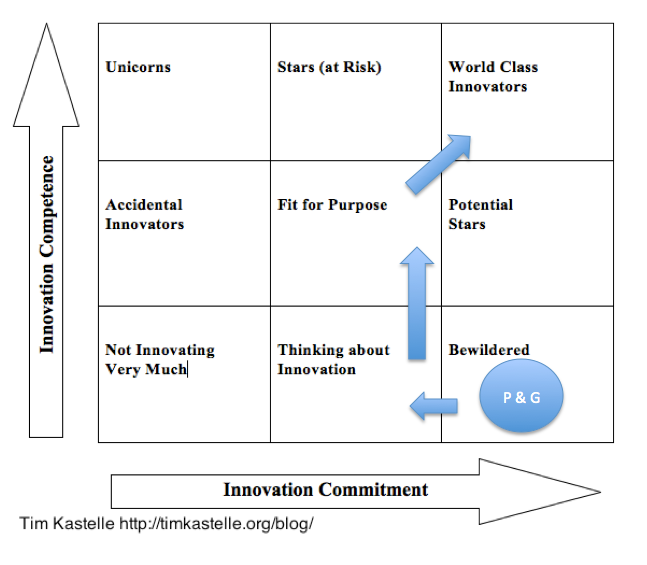
In the late 1990s, their innovation program had lost its way. Successful product innovation was at the centre of their competitive strategy, but their performance had been slipping. P&G had reviewed their Research & Development strategy and increased their budget for the five years leading up to 1999, even though they already had one of the largest R&D budgets in the world.
The problem was that the increased R&D spend didn’t improve their performance – a classic case of Innovation Commitment increasing without an equivalent increase in Innovation Competence.
By 1999, R&D expenditure as a proportion of sales had increased from around 4% to nearly 7%, new product success rates were stuck at 35%, P&G had developed a huge collection of patents, but fewer than 10% of them were being used in actual products. The last one is the fact that still blows me away. The outcome of this was a drop in the P&G stock price from $118 per share to $52.
At this point, P&G was Bewildered. They were sinking a huge amount of resources into innovation, but they were not getting a very good return at all on this investment.
Their response to this state of affairs is well documented now – they initiated the Connect & Develop program, which was designed to use open innovation to improve their innovation outcomes.
The interesting thing here is that this wasn’t just another increase in Innovation Commitment – P&G’s first move was actually to decrease their innovation infrastructure. They significantly reduced their R&D spend, they changed their innovation metrics and they cut back on activities that weren’t leading to the kinds of outcomes they needed.
The next step was to use Connect & Develop to get more ideas out into the world – one of their major weaknesses previously. As they did this, they moved into the Fit for Purpose category. P&G got better at executing ideas, and they were learning about how to use their resources more effectively within the new open innovation approach.
The outcome of that learning was a diagonal move into the World Class Innovator category. Once they consolidated their learning, they reinvested money into innovation and improved their idea selection process, increasing their Innovation Commitment. They also started to come up with breakthrough ideas again – such as Swiffer. Their Innovation Competence took another jump forward.
In an interview with Stefan Lindegaard, Chris Thoen of P&G outlines some of the outcomes from the Connect & Develop initiative. Some of these stats come from him, while others come from other sources:
  • They have extensive research networks (both proprietary and open ones) that that regularly lead to the development of new ideas.
  • The percentage of patents in use in products has increased from less than 10% to better than 50%.
  • Their new product success rate has increased from 35% to better than 50%.
  • The percentage of new P&G products that include elements developed outside of the firm has increased from 15% to over 35%
The end result is that Procter & Gamble is now considered to be one of the most innovative companies around, and is certainly a world leader in using open innovation.
This case illustrates a couple of important points about The Innovation Matrix:
  • You can’t become a World Class Innovator in one jump. The dangerous thing about a lot of the case studies that we hear about is that they often make it sound as though highly innovative firms were either born that way, or that they were improved their innovation capability very rapidly to become world class. Neither is true. Becoming a World Class Innovator is always a process – it takes time and effort, and multiple steps.
    If things go well, you can move up diagonally – when an increase in support for innovation is matched by an increase in innovation outputs – the ideal outcome. Nevertheless, it will require the patience and focus to make multiple moves to improve.
  • If you’re Bewildered, a step backwards can help. When things aren’t going well, it doesn’t make sense to just increase what you’re currently doing. Instead of spending more again on R&D, Procter & Gamble instead cut it. What they realised was that they were not effective all the way through the idea management process.
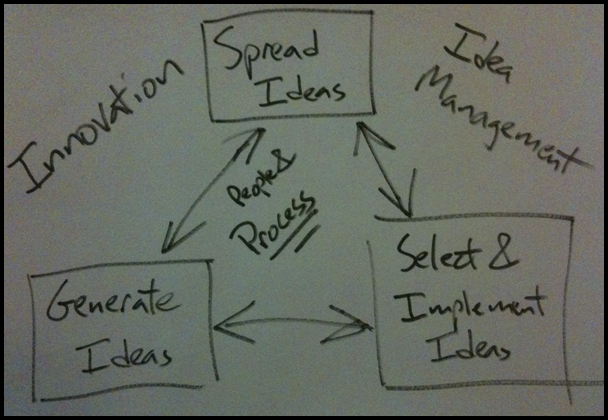
    They were generating TONS of ideas in 1999 – they had one of the largest patent pools in the world at the time. The places they had difficulty were in selection and diffusion. They would only pursue new product ideas with the potential to be $1 billion businesses – so they cut a lot of promising ideas. Connect & Develop enabled them to bring these ideas to market in collaboration with partners that better equipped to deal with the relatively smaller returns.
    This also led to more experimentation – no one expected Swiffer to become as big as it did. This is an idea that almost certainly would have been patented but then killed in the old system. These moves improved both their selection and their diffusion processes.
    None of this would have been possible without that first backward step.
I’m going to work on more case studies like this, because it’s critical to gain an understanding of how firms move through The Innovation Matrix. Such an understanding will help us figure out the best routes to take, and the best tools to use in different circumstances.
The value of that first step backwards if you’re Bewildered never occurred to me until I started to think about the Procter & Gamble case in more detail.
Stay tuned for more thoughts about how to use The Innovation Matrix to improve your innovation capability.
Note: most of the facts here came from two papers on P&G – one by my colleagues Mark Dodgson, David Gann and Ammon Salter, and the other by P&G employees Larry Huston and Nabil Sakkab.

Dairy producer The Collective has embraced social media as its major marketing channel


The Collective, which markets primarily through Facebook, Twitter and Pinterest, has gone from a staff of seven to 40 since launching and is one of the fastest-growing companies in New Zealand.
It was founded in November 2009 by chefs Angus Allan and Ofer Shenhav. Allan was the creator of Naked Organics and Ofer of Pitango Organic Cuisine, but the two former competitors decided to join forces and purchased the boutique Canaan Cheese business. After a crash-course in manufacturing dairy, it launched its range of soft cultured cheeses and haloumi in February 2010, followed by its gourmet yoghurt range in May 2010.
The Collective social media awardAllan says the marketing strategy has always been “to develop a fun brand and persona that is serious about what it makes”. From there the strategy grew and was all about ensuring the loyal community – or as he refers to it, ‘the herd’, which numbers around 3,400 on Facebook – was looked after.
“The key is showing a genuine personality and interest in the herd,” he says. “It’s the balance between having fun, sharing news, interacting and thanking our consumers. With all our communications we want to drive people to us, not drive people crazy. We don’t need to incentivise people for liking us; we want them to like us because they really, really do. We are very community driven and take social media and the people who are listening to us seriously.”
And, as well as creating a quality product, that approach appears to have paid dividends. Today, The Collective is New Zealand’s leading gourmet yoghurt brand – and it’s still growing (at around 250 percent, as evidenced by its 28th placing in last year’s Deloitte Fast 50).
And with product now stocked in Australia, Singapore, Spain, France, Hong-Kong and the United Kingdom, the word – and the herd – is spreading quickly. The company hopes to move into other markets like Canada, Brazil, Mexico and Germany, with a projection to achieve global sales of $30 million by June 2012, $100 million by 2013, $250 million by 2014 and $400 million by 2015.
The Collective social media awardThe Collective’s distinctive ‘Cow’ logo and subsequent ‘…no bull!’ taglines were developed in collaboration with design company pHd3, which was also involved in the ecostore rebrand. The packaging won a bronze Pent Award in the food, dairy products category, one of only three awards for that category. And it also secured two further awards at last year’s New Zealand Best Awards for Graphic Design Identity Development (small scale) and Graphic Design Packaging.
As for the Social Brands 100 list, Innocent took number one position.
The UK-based food and drinks brand that Coca-Cola has bought a majority share in made its name with packaging that spoke directly to its customers, and it was one of over 300 brands nominated following a crowdsourced nomination process on Twitter that took place in January. The report found that the best performing brands have a genuine, human voice on social platforms and aren’t afraid to get personal.

More and more innovation happens through communities

The future innovation winners will be those that manage to bring together current and potential innovation partners (companies rather than individuals) in eco-systems and communities. The big challenge is how to make such communities work and this goes for both types of companies.\

Service providers such as NineSigma, InnoCentive and IdeaConnection focus on challenge-driven innovation in which they help companies (seekers) connect with individuals as well as other companies (solvers) in order to get their problems solved. Such an approach can be applied within many different kinds of business functions and thus it can bring value to both types of companies.

Adjustable spectacles

MILLIONS around the world would have their lives improved by a pair of glasses, but cannot afford one. The problem is particularly acute in East Asia where, according to a recent report in the Lancet, as many as 90% of school leavers suffer from myopia. This high prevalence of short-sightedness (the comparable figure in the West is about 10-20%) is probably a result of the long hours of close work that many such pupils put in over the years of their youth. A visit to an optician to get a pair of spectacles with custom-made lenses will correct the problem, of course. But at a price not all can afford.
How to help such people is a problem with which Joshua Silver has been grappling for many years, while continuing his day job as an atomic physicist at the University of Oxford. His answer is cheap, self-adjusting glasses designed so that users can alter the power of the lenses in order to correct their own eyesight.
This idea is not new. The first published example of a variable-focus eye glass that Dr Silver can find is the “dynamoptometre”. This was described by Dr Cusco, a Parisian physician, in a paper in La Nature in 1880. Cusco's tabletop contraption involved a fluid-filled lens that could be adjusted by pumping water in and out. Dr Silver's first lenses, developed in the 1980s, worked similarly. They consisted of two polyester membranes with a water-filled gap between. The more water in the gap, the greater the curvature of the lens and thus the greater the magnification.
Over the years Dr Silver has refined the design. Instead of water, he employs a transparent silicone fluid developed by Dow Corning for use in scientific instruments. And instead of the original, rather goggle-like design, the latest version has light, thin frames. He has also founded the Centre for Vision in the Developing World (CVDW), and produced more than 40,000 pairs of adjustable glasses. Some have been used in trials, including several in rural China and India, in which young people with poor vision in at least one eye were able to correct their own vision.
That is done with a pair of small syringes attached, one to each side of the frame (see picture). Each syringe is operated by turning a small dial. Using one eye at a time, while looking at an eyechart, the wearer alters the curvature of the lenses until he can see clearly. When he has finished, he seals the lenses with clips and detaches the syringes.
Dr Silver reckons it will be possible to make this version of the glasses for about $20 a pair, and perhaps much less than that. They would come as part of a kit that included instructions and the eye chart. Later this year, with the support of Dow Corning, the CVDW hopes to begin the production and distribution of 50,000 pairs to China, India and Indonesia.

User-adjusted glasses could also help with eye conditions besides myopia—for example presbyopia, a common age-related condition that diminishes the ability to focus on nearby objects, and thus to be able to read. Dr Silver suspects adjustable reading glasses may find a role in the rich world, too. And one pair, at least, has already done so. These are at Lézard Bleu, a restaurant near Dr Silver's home in Vieussan, in the south of France. They have had their syringes attached permanently, so that diners who forget their reading glasses can use them to focus clearly on the menu.

Vacationers send digital ‘wish u were here’


  Easy online access and a steady supply of mobile devices means people are more plugged in than ever on vacations.

A new study published in the journal Annals of Tourism Research shows that wireless use is higher on vacation (40 percent) than at home (25 percent) and people use the Web more to plan vacations (80 percent) than for work (70 percent). The number of people using smart phones has tripled.
“Travelers are using their laptops and phones more often, and not just to plan vacations,” Vogt says. “Since Wi-Fi is available at most destinations, tourists are checking local weather forecasts, transportation schedules, restaurant recommendations, fishing reports, safe bicycling routes, and much more.”
“We hope to conduct more research across the various stages of vacations,” Vogt says. “This will help vacation service providers better understand what information travelers are looking for during trip planning and how it differs from the details they’re searching for after arrival.”

Tuesday, August 14, 2012

Value Added: Tim Ogilvie has a habit of turning around enterprises


When veteran entrepreneur Tim Ogilvie, a District-based business consultant, told me his job involves getting people to turn actions into habits, I  perked up.    He is working on big stuff, like changes in the habits of health-care workers and patients that will add years to people’s lives.   And he is sweating smaller stuff, like helping greeting-card employees come up with a hit for the holiday season


One health-care assignment involved Pfizer. Sales of the pharmaceutical giant’s Nicorette pill and patch to help people quit smoking were flat.
Ogilvie’s firm, Peer Insight, helped the company build loyalty among customers by setting up a phone-based coaching service for users of the drug. The coaches helped people establish new habits for dealing with stress, such as eating a carrot or carrying on a conversation with a colleague — and using Nicorette — instead of lighting up.
He produced similar results for Hallmark, the greeting-card company. A group of employees had stopped participating in an interoffice contest designed to bring new ideas to market because they were getting negative feedback on their proposals. In other words, they were losing.
Ogilvie’s team had to figure out a way to keep everyone involved. Their answer was to have more-frequent, shorter contests that let more people win, boosting positive feedback, the trigger for habit formation.
Ogilvie, 54, is an interesting guy who has been circulating in Washington’s entrepreneur scene for years, with stops at the Kaiser Associates consulting firm (founded by Michael Kaiser, president of the John F. Kennedy Center for the Performing Arts) and at a start-up focusing on mail lockboxes called Brivo Systems, from which he cashed out about 10 years ago.
What I learned from my two-hour interview with the practicing Buddhist is his belief in the ability of habit to change people’s lives for the better. He sprinkles his e-mails with sayings such as this one from Vietnamese monk Thich Nhat Hanh:
“Habit energy is the most powerful force in the universe.”
Ogilvie’s 14-person consulting firm, Peer Insight, grosses a couple million dollars a year from projects that last several months and range from $100,000 to $400,000 a pop. The clients are generally big corporations such as Hewlett-Packard, Intel, Computer Sciences, Procter & Gamble, Kimberly-Clark, and organizations such as AARP and the Good Samaritan Society.
Much of the work involves training a client’s employees how to treat customers. A two-day workshop that helps middle managers might cost $30,000.
Ogilvie earns a healthy income that I am pretty sure ranges from the low- to mid-six figures. For that, he works about 55 hours a week at his Capitol Hill offices on Pennsylvania Avenue SE.
“When you want to create a new customer experience, that’s where we come in,” he said. “The thing we found we are good at is introducing new services that help develop really sustainable habits.”


Rest Devices' baby onesie -designed to monitor infants as they sleep


Parents hardly think twice about buying avideo monitor or movement-sensing pad to make sure their bundle of joy is sleeping soundly through the night.
So what about a onesie embedded with sensors that can report on baby's breathing, temperature, and movement? A Boston startup called Rest Devices hopes to have the product on the market later this year, aiming for a price somewhere between $100 and $200. The package would include three onesies, a small turtle-shaped transmitter that clips onto the front with magnets, and a plug-in base station that would send data from the nursery over a home's WiFi network. (Another option is that the transmitter could communicate directly with a Bluetooth phone.)
The last time I wrote about Rest, the company was known as Nyx Devices and was developing a form-fitting SleepShirt that could help diagnose problems like sleep apnea. CEO Thomas Lipoma says they're still selling a version of that shirt to sleep researchers, but that the onesie is their main focus. (Lipoma is on the right in the photo, with Dulcie Madden, Rest's head of business development.)
"New parents want to know how their baby is doing at all times," says Lipoma. "This can tell you if your baby is on her stomach or her back, if her temperature spikes, if she's moving around, and if she's breathing normally." That last factor, of course, is a major fear for parents, who worry about sudden infant death syndrome, or SIDs.
onesie.jpgThe stretchy green bands on the onesie will collect information about the infant's respiration as her chest rises and falls. Temperature and movement sensors will be built into turtle — which right now is produced by a 3-D printer at Rest's Leather District headquarters — and an audio monitor will be built into the base station. The whole system will be able to send alerts to a mobile phone, or log data from night to night on a website, allowing Mom and Dad to look for trends. "We like to call it 'quantified baby,'" says Madden, referring to the "quantified self" data-gathering movement.
Rest has raised $500,000 in funding so far; Lipoma says they may raise more to support the onesie's launch. Initially, it'll be sold through the Rest Devices site and Amazon.com.

40 examples of open innovation and crowdsourcing


40 Examples of Open Innovation & CrowdsourcingWe can call it open innovation, crowdsourcing or co-creation – or something else. In short, it is about bringing external input to an innovation process and this is no longer a buzzword.
Companies are learning that they must embrace this paradigm shift of innovation in order to keep up with the competition and those that are lagging behind, well, they will find themselves to be in big trouble in the coming years.
This list of corporate initiatives is worth looking into if you want to get an idea of what is happening with the open innovation, crowdsourcing and co-creation today.
NOTE: The process of bringing external input into an innovation process requires lots of work that is often not visible to the public. So when you go through this list of examples, please remember that these companies have other initiatives related to open innovation.
In this competition, Audi asks questions such as: How will people work in production? What qualification concepts and/or kinds of cooperation will the future of production require? I like this initiative because it goes beyond the usual quest for ideas on products and services.
This open space allows Akzo Nobel, a producer of paints, coatings and chemicals, to reach out to individuals, companies and the academic world on a non-confidential basis. It is about making the connections, getting the discussions started and then look into what can happen.
An entry site for getting in touch with BASF with regards to joint innovation efforts.
Pearlfinder is Beiersdorf’s Web platform for open innovation and the basis for a trusted network with external innovators. External partners are able to access Beiersdorf’s confidential scientific challenges in order to propose appropriate ideas and solutions which may lead to joint collaborations or business.
Cisco iPrize

Why has this competition not been continued? Cisco has many other innovation initaitives, but this was the most public one I have noticed in recent years. It worked well so hopefully it will return.
This is a community in which Clorox works with consumers, inventors and partners. I recently did an interview with Greg Piche, the guy behind this initiative, and he revealed some advanced thoughts and insights on making communities work. Interesting project to follow.
DSM provides a good example on how a b2b industry such a chemicals can develop a more open innovation mindset. DSM has also been a driving force in developing Chemelot as a community for the chemical industry.
This is a platform in which GE reaches out to businesses, entrepreneurs, innovators and students with breakthrough ideas on energy issues. There has been 2 challenges sofar. It has been great to see how GE has experiemented with social media on this initiative. Hopefully, they will continue this initiative.
The G-WIN program at General Mills has received several industry awards. You can get an idea on why by checking out these five tips by Jeff Bellairs on how to jumpstart an open innovation program – great insights!
HP Labs’ Open Innovation team pursues and coordinates collaborations with researchers and entrepreneurs in academia, government and business. Well, it seems to be more about academia and government than business. Does HP have other business-directed initiatives?
Intuit did great work a few years ago. The site is still up, but why is there almost no activity?
Although Lego is one of the companies in the world with the most external touchpoints (especially towards their consumers/users) and great successes such as MindStorms, they did not have a formal open innovation strategy until recently. This is changing and it shows. One example is LegoCuuso, which I briefly described in this blogpost. Lego is one of my favourite companies : – )
The world’s first open-source community of car designers and fabricators. It is actually pretty cool!
The MWV Exchange seems like a fairly standard system for MWV to engage with external stakeholders. However, I have met with the people behind this initiative and I like their aggressive thinking, which I imagine will help them turn this into some interesting in the near future.
I believe medtech companies have lots of potential for open innovation, but we don’t see many whole-hearted initiatives. I give Medtronic credit for trying, but there is definitely room for improvement.
As Nokia fights for its life, the company also turns to consumers with their IdeasProject. Not so long ago, I attended a presentation on IdeasProject and I liked how they talked about the rise of the amateurs. This might be too late, too little from Nokia, but they are at least trying now.
The poster boy of open innovation showed us the way, but now the Connect+Develop site needs to develop. They have taken the first step with a design redo – a good start – and I know they are working on further developments. I look forward to see how the great people at P&G will rise to the challenge and revive the innovation engine at P&G once again.
Although, Philips seems to lack a portal or entry site for their open innovation efforts, they are still very much committed to working with external partners. I have learned this through my interactions with them and it is clearly stated on their website.
Psion started out strong with their open innovation efforts and although they have been slowed by the global crisis, you should still take a look a their community called Ingenuity Working.
Note: Psion has been taken over by Motorola and it will be interesting to see what will happen with their open innovation initiatives.
Open innovation brings new business models. This is about social product development.
The Global SAP Co-Innovation Lab (COIL) Network enhances the capabilities of SAP’s partner and customer ecosystem through an integrated network of world-wide expertise, and best-in-class technologies and platforms. Sounds good, right? I also like SAP’s efforts on communities as I believe they are a very important source for innovation today and even more so in the future.
The GameChanger program encourages inventors outside and inside the company to come up with creative ideas. The program is run by great people who know how to make things happen.
MyStarbucksIdea was one of the early crowdsourcing-like initiatives that gained widespread attention. This is rightfully deserved, but when you learn that only about 0.05% of the ideas submitted are executed, you need to consider what kind of success this is. I often say that the marketing guys can hijack innovation initatives. This is a great example of marketing success and less of a good innovation story.
This entry site for collaborating with Unilever is pretty much what you can expect from a global FMCG company. If you go behind the scenes, I like how Gail Martino, an open innovation manager at Unilever, looked into how to identify and develop critical personal competencies for open innovation success a few years ago.
Open Xerox is the place where you can experiment with technologies being developed in the Xerox labs around the globe.
Don’t miss out on this advice on open innovation by Linda Beltz from Weyerhaeuser!
I am going to stop my list now, but I could also have added these initiatives:
BASF Future BusinessBombardier – YouRail Design Contest
Challenge.gov – government challenges, your solutions
Coloplast – Innovation By You
Dell IdeastormDHL – City Logistics Open Innovation Contest
IBM – Collaborative Research Initiatives
Fiat Mio – the crowd helps make a car
Kraft Collaboration KitchenLG – Collaborate and Innovate portal
Lufthansa – Air cargo innovation challenge
OpenIDEO – Solving big challenges for social good
Reckitt Benckiser – Idealink
Toyota – Ideas for good

Amazon delivers Innovation


Amazon Delivers InnovationCame across a Wall Street Journal article recently that caught my eye, an article about Amazon Lockers. The concept is pretty simple. Amazon offers customers in select locations the option of having their package delivered to an Amazon Locker instead of to their street address. When the package arrives they receive an email letting them know where to pick it up along with the code to unlock it, and because most of the lockers are being placed in locations like convenience stores, often the customer can pick up their package 24 hours a day.
This is a great potential innovation for the segment of their customer base that has trouble receiving their packages – either because they live in an apartment or condo that is difficult to deliver to, aren’t home to sign, or because they are worried that their package might be stolen.
But the motive for the experiment is not purely an altruistic customer service one, companies like Amazon pay up to 20% more to have packages delivered to a residence. So, delivering a package to a locker helps Amazon save money too – helping to offset the costs of installing and maintaining the lockers. And as a bonus they serve as OOH (Out Of Home) advertisements in a context where people’s minds are already open to buying things.
So, what did the Wall Street Journal miss?
The Wall Street Journal missed the most important part of this whole idea, and one of the potentially most innovative parts of it. If you’re still missing the hidden golden nugget, one more hint before the reveal – think Amazon Web Services (AWS) including services like EC2 (Elastic Computing Cloud) and S3 (Simple Storage Solution). Now you should see that the real innovation nugget here is that what may look at the outset as a service innovation, is actually a platform innovation.
The same problem that has led Amazon to create the potential innovation that is Amazon Lockers, is a problem for all other online retailers. So, Amazon and their customers definitely benefit from the lockers, but they likely can also be leveraged by any retailer that sells their goods on Amazon. AND, in the future there is no reason that in much the same way that Amazon productized S3 and EC2, Amazon could also productize Amazon Lockers and sell it as a service that any other company can purchase and use.
Package DeliverySo who should have come up with this potential innovation?
FedEx, DHL, UPS, and the US Postal Service all missed this as a potential innovation that any of them should have actually developed. The inspiration for this potential innovation was sitting in full view all along. The US Postal Service installed multiple mailbox solutions in many subdivisions long ago to increase efficiency, and make it so that anyone receiving a package receives a key in their mailbox that opens a larger box in the same unit for package retrieval.
Final Thought
Are Amazon Lockers a good idea? A potential innovation? Yes, I think so. Whether they make the transition from interesting experiment or invention to innovation (through adoption) we will wait and see. But the fact that Amazon is expanding their test is a good sign that the transition from invention to innovation will be made. To close, I would just like to say that Amazon has some other possibilities they could (and likely will) explore, including:
  1. Pursuit of space rent reduction through use of the touch screen to suggest certain products for purchase that the host store might sell.
  2. Show suggested products from Amazon with a ‘send me more info’ button to email the customer more information about a product shown on the screen (to their email or possibly to their phone)
  3. Allow the customer to announce via social media that they’ve just picked up their product
  4. Pick select customers to win a prize based on some kind of points scheme related to their number (or value) of pickups – or just by pure chance – (check door 32 and you might be a winner) – adding an element of fun, mystery, and anticipation to the customer’s package retrieval experience
  5. Allow people to order popular products from what is effectively a kiosk, either for immediate delivery or via Amazon Prime delivery back to the locker in a couple of days

Starbucks’ Refreshing Innovation


Starbucks' Refreshing InnovationSometimes it is better to be late than never. Starbucks recently announced a new line of energy drinks – Starbucks Refreshers. There are two flavors Cool Lime and Very Berry Hibiscus and instead of copying other energy drinks, and use the same active ingredients as the usual suspects, they instead decided to use something uniquely Starbucks – green coffee extract.
Starbucks Refreshers are coffee drinks that don’t look like or taste like coffee, but provide the caffeine jolt that many of their customers are looking for nonetheless. And as an added bonus, they are coffee drinks that are much lower in calories and fat than many of their traditional hot or iced lattes. Coffee for the lactose intolerant too!
Starbucks has done something else smart, and that is that they have created a self-reinforcing product loop that allows for three different preparations and use cases for the same basic product, all in a single summer product launch:
  1. A customizable cafe preparation with multiple sizes and fresh fruit
  2. A canned, chillable pre-mixed portable preparation
  3. An extremely portable VIA DIY preparation without the water
In addition to being sold in their stores and licensed locations, the can and VIA preparation can be distributed via Starbucks’ existing grocery distribution channels.
Starbucks Refreshers are a great example of taking components of your brand and other organizational assets and leveraging them to create new products that people might not have thought about you creating, but that feel like natural extensions to them instead of a stretch.
Starbucks Refreshers are also a great example of looking at your raw materials in a new way and as a result a new product solution in born.
What might happen if you looked at your raw material inputs in a new way?

Monday, August 13, 2012

Startups put family physician on demand from middle & upper-middle classes

BANGALORE: Even as more super-specialty hospitals spring up across Indian cities, a number of entrepreneurs in the booming healthcare sector are taking a contrarian approach and recreating the old model of the family physician

Responding to demands from middle and upper-middle classes for a family doctor who knows his patients and their medical history intimately, these new ventures are creating chains of neighbourhood clinics that offer the intimacy of personal care alongside the benefits of digitised patient records and online referrals to specialists when needed. 

"I was sick and tired of going to hospitals, needless tests and procedures," says TRanganathan, a former professor at IITBombay, who moved to Bangalore with his family seven years ago. His quest for a local physician ended this year when he found Modern Family Doctor, a startup that has set up a chain of clinics in India's technology capital. 

"A good family doctor is affordable, knows your medical history and does not scare you by prescribing needless tests," says the 79-year-old, who now works as a management consultant. 

In the past year, nearly half-a-dozen such startups have come up across Indian cities aiming to re-establish a bond between patients and a physician. 

Modern Family Doctor, founded by former Cafe Coffee Day CEO Naresh Malhotra, operates 13 clinics in Bangalore and was born out of a personal need. Malhotra found that his aged mother needed to visit a hospital for every little ailment and even a casual blood pressure test. 

Execution is Key for These Clinics 

Malhotra's chain of local clinics under a single umbrella is modelled on the way retail outlets are rolled out, a business format he is well versed with. In the next three years, Modern Family Doctor aims to have 300 clinics across Pune, Chennai and Delhi. 

"Execution is key for these consumer-facing businesses. A lot depends on the business model, scalability and a team that can execute," says Ash Lilani, president of Silicon Valley Bank India, which invested Rs 10 crore in Modern Family Doctor after Malhotra pitched the idea to him on a flight. 

This year, the healthcare and life sciences sector has received the most funds from risk capital investors, with $817 million invested in 29 deals, according to data research firm Venture Intelligence. 

Other marquee funds such as Catamaran, set up by Infosys co-founder NR Narayana Murthy, are also joining the action. Catamaran, along with Reliance Venture Asset Management and US-based BlueCross BlueShield Venture Partners, invested 20.5 crore in Mumbai-based Wellspring Healthcare founded by the father-son team of Gautam and Kaushik Sen. The senior Sen, Gautam, is a general surgeon and oncologist while his son used to work at consulting firm Bain & Co in Delhi and Boston. 

Also in Bangalore, doctors-turned-entrepreneurs Santanu Chattopadhyay and Shantanu Rahman have set up a chain of 14 clinics through their venture NationWide Primary Healthcare Services. This chain of family physicians and paediatric clinics expects to have a nationwide network of 250 clinics. Chattopadhyay, who worked at the London Medical School, teamed up with Rahman, who had a stint with the UK's National Health Services, to set up the venture. Experts such as Devi Prasad Shetty, cardiac surgeon and founder of Narayana Hrudayalaya, say reviving the concept of a family doctor is an excellent trend.

"A hospital is the last place that a patient should visit; continuity of healthcare is important," he says. Most of these new ventures are using technology to provide value-added services to patients. These include web services that schedule appointments with local doctors. Among the ventures that have sprouted in this area isPracto, founded by two graduates from the National Institute of Technology, Surathkal. 

Practo's platform manages 10,000 appointments a day with 8,000 local doctors who run neighbourhood clinics. Last month, Sequoia Capital invested 25 crore in Practo. "You can discover a good food joint or order pizza online, but cannot schedule an appointment with a local doctor," says Shashank ND, the chief executive of Practo.