Showing posts with label apparel. Show all posts

Sunday, June 8, 2014

Hyper-customizable men’s shirts offer over a billion options

Consumers come in all shapes and sizes and have their own individual tastes, meaning that mass-manufactured fashion often falls short. We’ve already seen companies such as Stantt and Threadmason offer up to 50 different shirt size options, and now Original Stitch is enabling customers to truly personalize shirts with their choice of fabric, color, pattern and design, providing over a billion possible permutations.
Members first choose whether they want a smart or casual shirt. They then go through a 14-step process to decide almost every element of the shirts design, including obvious choices — such as the type of cut, whether they want long or short sleeves, collar styles, or a pocket — as well as more subtle elements like the fabric of the inner collar and cuffs, button design and even the inclusion of a monogram (and it’s font, color and location). The details of every order Original Stitch receives are sent to tailors in Japan, who make each shirt on demand using software-integrated fabric cutting machines. The shirts take around two weeks to be created, but the process keeps costs down to between USD 75 and USD 120.
Watch the video below to see a demonstration of the custome shirt generator:
Original Stitch essentially aims to do for the global shirt industry what Nike iD is doing for sneakers, tapping into a USD 10 billion a year market

Alice + Olivia: A Global Brand Spawned by a Need for the Perfect Pants

alice-olivia-1 (1)
If, as Mark Twain once proclaimed, “Clothes make the man,” do trousers then make the woman? They do if you’re Stacey Bendet.
Thirty-six-year-old Bendet is the founder and creative mind behind Alice + Olivia, a $150 million global women’s clothing company that is little more than a decade old. Bendet described the origin and rapid-growth of Alice + Olivia at the recent Retail and Consumer Goods Growth Summit, organized by Knowledge@Wharton, Wharton’s Jay H. Baker Retailing Center and Momentum Event Group.
The company’s origins, she said, can be traced to her quest for a perfect pair of pants. “Every girl has 100 pairs of jeans in her closet,” Bendet noted. “I wanted sexy novelty pants,” the kind that could be the focus of an outfit. When she couldn’t find any that fit the bill, Bendet created her own. When she was done, the former apparel company web designer said to herself, “Yes, girls will buy these. They fill a void in the market.”
Cut slim at the hips, her signature trousers create the coveted appearance of a lean body and elongated legs. Women did buy them — and then the question became what to pair them with. “It was a conscious evolution,” said Bendet, who serves on the board of the Baker center. “People in the stores said, ‘We need tops to go with the pants.’” 
“I saw women paying $8,000 for a gown, and I said, ‘I can make that dress for $1,200.’”
That led to cashmere sweaters and eventually skirts. “Then I heard, ‘Everyone’s doing separates, but no one’s doing contemporary dresses that are chic and cute,’” Bendet noted. From there, it was a short leap from fabric to footwear. “At one point, I realized I was paying $1,000 for a pair of shoes, so I said, “Let’s do shoes that fit with our price-point,” she added.
The Alice + Olivia price-point is typically somewhere between $150 and $750 per item, with the exception of leather jackets (which can extend into four figures) and party dresses and gowns, which Bendet added to the collection. “I saw women paying $8,000 for a gown, and I said, ‘I can make that dress for $1,200,’” she said.
Although there’s a youthful vibe to Bendet’s clothes, the mother of two designs for all ages, whether it’s a dress for a girl’s bat mitzvah or prom or a mother’s gown for her daughter’s wedding. The Alice + Olivia collection is aimed at women who want high-fashion, couture-quality clothes but aren’t old enough or affluent enough to afford an $8,000 gown, Bendet noted.
Girls Just Wanna Have Fun
As Bendet introduced each new item to what is now a complete lifestyle brand, her focus was always on “thinking about what girls want and need.” When she says “girls,” Bendet really means women — women who enjoy classic, feminine, distinctively “girlie” kinds of clothes. She designs each collection with four types of women in mind.
“For instance, one might be the fashion editor who looks like she’s heading to the Conde Nast building or just stepped out of Vogue,” said Bendet. “The second would be the uptown girl who shops on Madison Avenue. The downtown girl would be wearing something short. And the fourth one is variable, the Bohemian or seasonal girl.”
While these four archetypes will change with each collection, Bendet said what doesn’t change is a focus on the qualities that fans expect from the brand — clothing that is young, fun, flirty, sophisticated and whimsical. “I’m pretty dictatorial about what is us and what is not us,” she noted. “I don’t design anything I wouldn’t wear myself.”
“So much of social media today sounds like advertising. It needs to be real. If it’s a staged photograph, it doesn’t do as well as if it’s me waving in the mirror.”
For example, AIR, a line of jersey and knit pieces, was born when Bendet became a mom and realized her clothes might need to change to fit the vagaries of parenting. “I decided perhaps that a silk ball gown isn’t practical at the park, but I still wanted my clothes to be cute and fun on the weekend. They also needed to transport well and not wrinkle, yet still feel like me.” 
From Hemlines to the Bottom Line
There was no business plan when Alice + Olivia launched in 2002 and no plan for global expansion. At one point, Bendet recalled, her business partner, Andrew Rosen, the founder of men’s and women’s clothing line Theory, said, “Stace, look. You’re running a $75 to $80 million business like a $20 million one. You’ve got to grow up a bit.”
That’s when Bendet made a decision not to expand for a time. Although she noted that she prefers picking out fabrics to dealing with procedures and people, Bendet switched her focus to putting a level of management in place that would elevate Alice + Olivia to a $150 million business in three to five years. The strategy worked — last year, Alice + Olivia opened its first non-U.S. stores in DubaiKuwaitTokyo and Hong Kong, bringing the number of free-standing boutiques — including those in New York, Connecticut and California — to 22. In addition, Bendet’s clothes are available in more than 800 select department and specialty stores worldwide, including Saks Fifth AvenueNeiman MarcusBergdorf Goodman,Lane CrawfordIsetanHankyuHarvey Nichols and Harrods, as well as online at aliceandolivia.com and prominent web retailers including Net-a-Porter and Shopbop
“We need to do more with the technology for manufacturing. Three-D printing for clothing would be innovative.”
In terms of figuring out which pieces will sell, “some of it is evolution and some of it is stream of consciousness,” she said. “Street style influences couture design. As you get bigger and more global, you need reports from the field as to what’s happening in Asia and Europe.” Bendet also finds inspiration from trips she takes. “When I went to Istanbul, I bought a bunch of tablecloths and bedspreads, and then I used the look of those to make fabrics,” she noted.
‘We’re a Modern Brand’
While Alice + Olivia is a lifestyle brand to the women it outfits, for Bendet, it’s her life. She pointed out that she is involved not just in the design of the clothes, but also the whole process of production, the look of each boutique, the sales culture and how the brand is promoted.
“When a woman walks into the store, I want the clothes to fit perfectly, so she can walk out and wear it that night,” Bendet said, adding that a big chunk of her day is also spent on social media. “We’re a modern brand. We use social media so customers get insight into our world and where we are traveling. I fell in love with Instagram. I like it more than Twitter because it’s visual. We now have 370,000 followers.”
She also likes a new app called Storehouse, which allows users to combine text, photos and videos. And while fashion magazines are still important for building and promoting fashion reputations, Bendet said they are not the only voice anymore. “They’re still powerful, especially if [celebrities] are wearing something from our collection,” but bloggers can be big influencers as well if they have a large following, she noted.
Bendet handles the brand’s Instagram posts herself. “People will say, ‘It sounds so much like you.’ That’s because it is me,” she said. “So much of social media today sounds like advertising. It needs to be real. If it’s a staged photograph, it doesn’t do as well as if it’s me waving in the mirror. Followers want to see your world, spontaneously.”
Fans and followers get another look inside her world when they visit one of Alice + Olivia’s free-standing stores. While the architecture and the spaces themselves can vary greatly, she said, there are some signature elements that are common to each: molded wood, marble in the flooring, at least one mid-Century sofa and a “crazy chandelier.” Other variables can include design boards in the dressing rooms that feature fabrics and swatches similar to those that Bendet and her team use. An enlarged reproduction of one of her daughter’s drawings is displayed at another store. 
To work at an Alice + Olivia store, Bendet noted, employees need to spread positivity and strength. “[Our] employees are proud, happy, excited, energetic. If not, they don’t work there.”
Looking ahead, Bendet said she would like expand the brand into eyewear and make-up but definitely not menswear. She would also like to see more innovation in clothing production. “It’s done the same way today as it was 100 years ago,” she said. “You still break needles when you sew. It’s still a laborious process. We need to do more with the technology for manufacturing. Three-D printing for clothing would be innovative.”

Monday, January 14, 2013

ProperSuit - Custom suit service

What it is: A bespoke suit service now available in 12 major cities.
Why it's cool: Already a hit in Silicon Valley, Proper Suit takes the hassle and pretentiousness out of great custom-made suits.
Once you've been measured by one of the company's tailors, all you need to do is send a photo or explanation of what you're looking for and the team will get to work.

Saturday, January 12, 2013

Two Tailors Have A Simple Concept That Could Change The Way Men Buy Dress Shirts

When McGregor Madden started his company, Proper Suit, he noticed something that gave him an idea for a new business.
"We had men buying $1,000 suits, yet their dress shirts never fit them," said Madden, who is a tailor by trade. "Dress shirts were a commodity, something you had to purchase, but very few men put thought into how they fit under this expensive suit."
With that experience in mind, Madden and his business partner and fellow tailor Richard Hall co-founded subscription service Hall & Madden.
For $150, men get three dress shirts customized to fit them based on height, weight, and other measurements provided by the customer.
The shirts are as high-quality as those manufactured by Hugo Boss, Burberry, and Gucci, but for about one-third of the price, Madden told us.

"We actually reverse-engineered our shirts based on these designer labels by finding their suppliers and working directly with them," Madden said. "Then we added even more luxury features, like thick mother-of-pearl buttons and handmade single-needle stitching construction, to make the shirt even better."
Madden said the service is "all about the product."
"I'm a tailor by trade, so I tried to be meticulous about the product, how it was made and the fit," Madden said.
Madden is able to offer the shirt at such an affordable price because he doesn't have the overhead costs of store rents or associates, he said.
The service has 1,000 subscribers in just a few months. Hall & Madden's next step is to open an office near Chicago's Merchandise Mart.
Madden said his typical customer is a young man who is just starting out in his career.
"I think that a lot of men graduate business school and have no real idea of how their work clothes should fit, or what they should be wearing," Madden said. "Our goal is to ease that stress and provide a product that works for them."

Friday, December 28, 2012

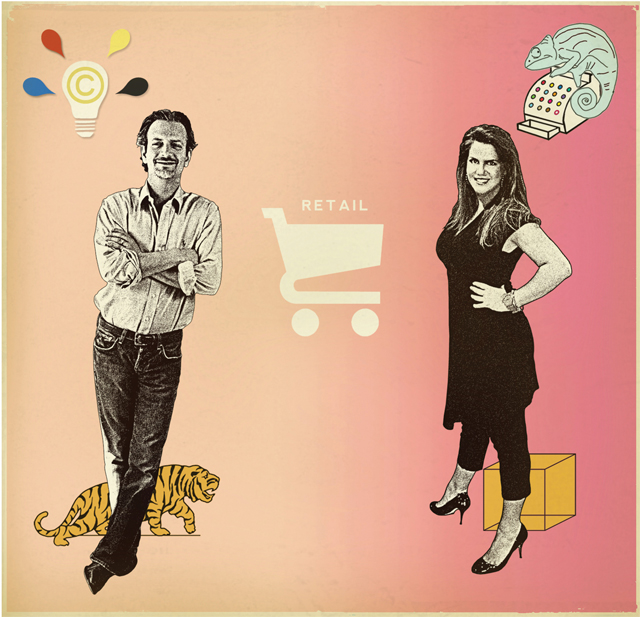
How To Make Retail Exciting Again


Rick Barrack
Chief Creative Officer, CBX
Rachel Shechtman
Founder, Story
The dialoguers: Rachel Shechtman is the founder of Story, a Manhattan boutique that updates its theme--and products!--every four to eight weeks. Rick Barrack is the chief creative officer at branding firm CBX, which recently helped Duane Reade do the impossible: execute a redesign to become cool (at least, as much as any drugstore can be cool) .
SHECHTMAN: When we think of the next generation of retail design, we think about storytelling. My rule: 70% of an experience should be what consumers know and 30% should be surprise and delight. What you did with Duane Reade's package design is all delight. Take a pretzel, for example. Everyone knows what it is, and there's not much product differentiation. But you put it in a bag with black-and-white stripes that look like the Empire State Building, and suddenly consumers think, Oh my God, this is so cool.
BARRACK: It creates an engagement opportunity. Our models to create that engagement are really the same in many ways; we're just doing it on a much more mass scale.
SHECHTMAN: Why are people going to brick and mortars at all? For the experience.
BARRACK: The dynamics of e-commerce, as it has evolved, created a new shopping behavior. People demand more information. And now, outside of e-commerce, we have to provide that as well.
SHECHTMAN: So many e-commerce brands have just been nailing it, and a lot of brick-and-mortar retailers got lazy. Now the older sibling is looking up to the younger sibling.
BARRACK: Well, e-commerce has provided exclusivity, and people want that in retail stores. Duane Reade narrowed offerings to make it feel more relevant--and exclusive--to New Yorkers: At the Wall Street location, the sushi bar is called Up Market and there's a stock ticker; in Williamsburg, there's a growler bar. It's telling the consumer, We understand the way you live, where you live, and what you need from us.
SHECHTMAN: Consumers also want to know the retailer's point of view. My store is like a magazine: There's the editorial side and the publishing side, as we partner with brands for sponsorship. We have to let our story drive the assortment, rather than let the assortment drive our story. And when that story is sincere, it will spread just like a viral video, attracting all demographics, from 9-year-old Bella, who lives up the street, to my 65-year-old neighbor.
BARRACK: You have to walk in the shoes of consumers. When we start working with a brand, we ask, If this brand were a room, what would it look like? And then we'll build multisensual rooms to get a better sense of the product and its consumer.
SHECHTMAN: It's funny you say, "What would this brand look like?" I do a retail-experience test--walk out of a store and describe it as if it were someone you met at a cocktail party.
BARRACK: That's right. It's not rocket science. You have got to step out of your own skin and spend time there. We'll take clients on daylong expeditions to show them more interesting retail spaces--even if it's for package design--to get inspiration. We'll even take them to the local gym so they get a sense of the look of the community. It's a journey. You can't turn up the heat on a cake and expect it to taste the same. Good ideas need time to bake.
SHECHTMAN: It's really about using storytelling as a matchmaker between brands and consumers. And design is a big part of that. You're saying, "Hey, we're cool," without really saying it.

Jeans store uses QR codes to make shopping easier for men


We recently wrote about QThru, a system using QR codes to speed up the check-out process. Aimed at men who don’t like shopping, Hointer also uses the technology to break down the traditional retail model and help make clothes shopping pain-free.
Located in Seattle, customers walking into the store are greeted by a floor that contains only one pair of each model of jeans available. The jeans are tagged with a QR code that – when scanned using the store’s bespoke app – delivers a pair in the chosen size to a fitting room in the store and alerts the customer which room to go to. Once the jeans have been tried, customers can either send the jeans back into the system or swipe their card using a machine in each fitting room to make a purchase. The GeekWire video below shows the system in action:
Rather than forcing shoppers to contend with piles of clothes hoping to find the right size, Hointer simplifies the process using technology and makes buying a pair of jeans less stressful. How else can the retail experience be tailored to those who would otherwise avoid it?

Sunday, December 16, 2012

Bonobos - online retailer of men's pants

 http://www.bonobos.com/welcome/h7a

Andy Dunn, the co-founder and chief executive of Bonobos, fondly recalls hanging up 400 pairs of pants on the walls of his Gramercy apartment in 2007, when the Internet retailer was just getting off the ground.

Bonobos launched with the promise that it offered a better-fitting pair of men’s trousers. The Bonobos line has since expanded to include an array of colorful shirts, suits, swim wear, shorts and accessories.


Then, it was all about the pant — or, more specifically, the company’s signature, curved waistline designed for men with athletic builds.
Today, Bonobos is a full-fledged fashion label, operating from an office in the Flatiron district. It has 25 employees and a full menu of menswear, including fitted oxford dress shirts, wool cashmere suits and boat shoes.

“Feedback we’ve gotten from a lot of male shoppers since Bonobos started has indicated they wanted to know more about the clothes and how they fit before making a purchase,” said a Bonobos spokeswoman of the plan to open a Chicago showroom.

The company, started by Mr. Dunn and his Stanford Business School roommate, Brian Spaly, is also raising legitimate capital. On Thursday morning, Bonobos announced it had raised $18.5 million in a financing round, led by the venture capital firms Lightspeed Venture Partners and Accel Partners.
Jeremy Liew, a managing director at Lightspeed, and Sameer Gandhi, an Accel partner, will join the Bonobos board.
Although the first pair of Bonobos pants was sewn in Silicon Valley, the company’s success is rooted in Wall Street. The pants have found a cult following among young finance types who want something between the traditional Brooks Brothers cut and the thigh-hugging, slim-fit European style.
Mr. Dunn, a former private equity associate, said several customers from New York’s financial industry invested early. Prior to this latest round, the company had raised $7.75 million in angel funds from 75 individuals — with Wall Streeters representing 20 percent of the investors and 30 percent of the funds.
“Part of it was the downturn in the economy in 2008 and 2009 — they saw Bonobos as possibly a more interesting place to put their capital to work than some of the traditional investments,” Mr. Dunn said.
“I would meet with guys for coffee, and see what their enthusiasm was for the company, see what kind of advice they might have to be able to offer, based on the type of experience they had. A select few we invited into the company to become not only customers but investors, which was pretty cool.”
Although Bonobos are now sold throughout the country, Manhattan remains its largest market, accounting for one out of five pairs of pants sold.
Now, Bonobos, which sells exclusively online, will have to prove it has a truly scalable e-commerce business model.
As with some of its more successful counterparts, including Zappos, Mr. Dunn said that — beyond a flattering fit — his company if focused on obsessive customer service. The company, for example, offers free shipping and free life-time returns.
While those perks erode margins, Bonobos saves money by limiting its marketing budget. The company is heavily dependent on word of mouth, online ads and loyal customers.
Mr. Dunn says Bonobos currently has 32,000 customers, with a 50 percent rate of repeat purchases. After racking up $1.3 million in revenue last month, the company said it was on pace to reach $15 million in 2011.
Mr. Liew of Lightspeed — who has led investments in Kim Kardashian’s ShoeDazzle and LivingSocial, a Groupon competitor that recently raised $175 million from Amazon — said he was investing in companies like Bonobos because of the momentum in e-commerce.
While several years ago American customers were hesitant to buy most of their wares on the Web, today it has become de rigueur. For businesses, the online component is now seen as an essential tool for customer acquisition and retention.
“In fashion, having a direct relationship with customers, and being able to track it all the way through allows you to spend on marketing with confidence and you can’t do that tracking without that online experience,” Mr. Liew said.

Sunday, April 1, 2012

Teen Apparel Retailers Enjoy E-Commerce Boom

Apparel and accessories businesses are seeing faster growth than any other e-commerce product segment. [1] According to a recent report by eMarketer, the apparel and accessories category grew by nearly 22% in 2011, well ahead of early-adopter favorites such as books, music and video.
We believe the results stand as a testimony to why the development of e-commerce business features as the topmost strategy for all apparel companies including teen apparel retailers such as Abercrombie & Fitch, AeropostaleAmerican Eagle Outfitters and Gap Inc..

Amazing prospects in e-commerce business for teen apparel retailers
The apparel and accessories category grew by nearly 22% in 2011, with the total sales in the category standing at $34.2 billion compared to $28 billion in 2010. The trend is expected to continue with the revenue in apparel and accessories category expected to contribute nearly 20% of the total U.S. e-commerce sales in 2016.
This highlight the immense prospects in e-commerce business for apparel retailers. Additionally, we note that the growth of 22% in 2011 came at a time when the apparel industry as a whole was on the decline, which makes this finding even more significant in our view.
While the performance for brick and mortar stores started to crumble as a result of weak macro-economic conditions, direct business in the form of e-commerce, m-commerce and lately f-commerce stood out as a real growth driver in 2011.
An increase in direct business not just helped teen retailers increase their dwindling sales but also provided some respite in margins as direct sales carry higher margins compared to that for retail sales. The apparel companies also seem to have understood the importance of direct business with the growth of direct channels featuring as the topmost strategy for most teen apparel retailers.