Every two months, I pull together a community of innovators. We meet somewhere in New York City, usually a boardroom overlooking a park or cityscape. But last month we all found our way into an acting studio operated by The TAI Group to learn about storytelling.
The members of this group certainly already know something about the topic. They are senior executives at some of the largest corporations, partners in some of the most prestigious consulting and private equity firms, and several cutting-edge entrepreneurs. But the more you know, the more you realize there is to learn, and this group wanted to learn more about how to use effective storytelling to drive change in and grow their organizations.
The experience shocked me, to be honest. I considered myself an expert and snobbishly thought there was little more to learn. How wrong I was. Here are my two key takeaways from this session. Apply them today at your next meeting or phone call and I am willing to bet you will have a better result. 1) Use lots of LOTS. Our facilitator, Gary Lyons, senior coach at The TAI Group, told us a story and had us dissect what we remembered. Do this, and you will realize your audience is often checked out, comatose, or unable to hear or remember what you are saying. The key to engage them is to use lots of “language of the senses,” or LOTS. When telling a story, share with us what you see, smell, feel, taste, and hear. When you trigger a sense in someone, you bring them into the story with you. 2) Build on your story spine. At McKinsey, I was taught to open presentations with a standard structure: situation, complication, question, answer. TAI suggests you use a five-step structure and do so not just to open your presentation, but throughout your talk. They call it the "story spine": reality is introduced, conflict arrives, there is a struggle, the conflict is resolved, a new reality exists. These two tools caused a profound shift in our abilities to tell effective stories.
Not convinced? Let me try the story spine with lots of LOTS then: Reality introduced: A dark room is filled with 20 executives and entrepreneurs resting on chairs in rows facing two director chairs. The door closes, snuffing out the faint sound of New York traffic. Conflict introduced: Our facilitator, Gary, begins scratching markers on flip charts. He is there to teach us about storytelling. But all I can think about is, "This is a highly accomplished group; they know all of this already. Will we learn anything new?" Struggle: Gary tells us to use “language of the senses,” but someone complains, "You can't talk like that at a board meeting," to which Gary points out that if you talk differently than people expect you to, they are more likely to listen and remember. Conflict resolved: Gary gently bats back every concern this Type A group lobs at him, patiently walking us through the journey. By the end he has us on the edge of our seats. New reality: We close with a “before and after” exercise. One of our members gets up to practice a pitch; he is raising money for an energy tech venture. He starts speaking, but I just can't follow. When he finishes, I realize I have not heard a word. Gary coaches him--lots of LOTS, story spine, look us in the eye, take us in--and the speaker tries again. Now it is all waterfalls of electricity pouring down the mountain, the opportunity to create something and break through with passion. I heard every word, and so much more.
That is the impact that two tools can have in your ability to tell stories--about the company you are building, the project you are leading, the life you live. You can enroll people more completely and emotionally in your mission. Here is how you can put it to use now:
1) Think of a presentation or pitch you will be giving in the next seven days.
2) Write out your presentation as a story, longhand, on paper, using the story spine.
3) Brainstorm a list of LOTS (language of the senses) you want to embed into your story.
A 2009 study found that subjects solved twice as many insight puzzles when surrounded by the color blue, since it leads to more relaxed and associative thinking. Red, on other hand, makes people more alert and aware, so it is a better backdrop for solving analytic problems.
2. Get Groggy
According to a study published last month, people at their least alert time of day—think of a night person early in the morning—performed far better on various creative puzzles, sometimes improving their success rate by 50%. Grogginess has creative perks.
#3 Don't Be Afraid to Daydream
3. Daydream Away
Research led by Jonathan Schooler at the University of California, Santa Barbara, has found that people who daydream more score higher on various tests of creativity.
4. Think Like A Child
When subjects are told to imagine themselves as 7-year-olds, they score significantly higher on tests of divergent thinking, such as trying to invent alternative uses for an old car tire.
5. Laugh It Up
When people are exposed to a short video of stand-up comedy, they solve about 20% more insight puzzles.
When people are exposed to a short video of stand-up comedy, they solve about 20% more insight puzzles.
6. Imagine That You Are Far Away
Research conducted at Indiana University found that people were much better at solving insight puzzles when they were told that the puzzles came from Greece or California, and not from a local lab.
7. Keep It Generic
One way to increase problem-solving ability is to change the verbs used to describe the problem. When the verbs are extremely specific, people think in narrow terms. In contrast, the use of more generic verbs—say, "moving" instead of "driving"—can lead to dramatic increases in the number of problems solved.
According to a new study, volunteers performed significantly better on a standard test of creativity when they were seated outside a 5-footsquare workspace, perhaps because they internalized the metaphor of thinking outside the box. The lesson? Your cubicle is holding you back.
8. Work Outside the Box
According to new study, volunteers performed significantly better on a standard test of creativity when they were seated outside a 5-foot-square workspace, perhaps because they internalized the metaphor of thinking outside the box. The lesson? Your cubicle is holding you back.
9. See the World
According to research led by Adam Galinsky, students who have lived abroad were much more likely to solve a classic insight puzzle. Their experience of another culture endowed them with a valuable open-mindedness. This effect also applies to professionals: Fashion-house directors who have lived in many countries produce clothing that their peers rate as far more creative.
10. Move to a Metropolis
Physicists at the Santa Fe Institute have found that moving from a small city to one that is twice as large leads inventors to produce, on average, about 15% more patents.
Oregon architecture firm ideabox is producing this prefab tiny house, which comes pre-installed with IKEA cabinets, flooring, and closets. The “activ” house is about 750 square feet and costs $86,500, and you can pick the color scheme of IKEA accoutrements that you prefer. And unlike most IKEA stuff, it doesn’t come flat-packed and there’s no assembly required.
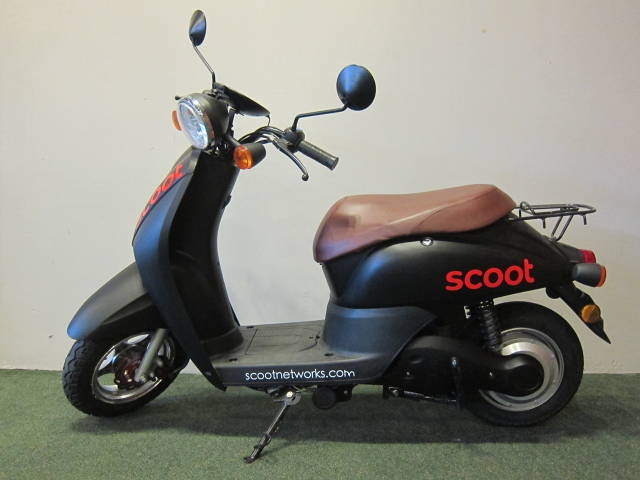
Want to get across town fast? Try a quick ride on one of Scoot’s scooters, soon to be available for rent around the city.
If you’ve always wanted to be part of a scooter gang (Heck’s Angels, anyone?) but don’t want to invest in a scooter, we’ve got great news: The Zipcar of electric scooters is about to be unleashed. Scoot Networks, a startup that emerged from the Greenstart cleantech accelerator, launched this week with the aim of bringing the joys of zipping around on a scooter to the masses. "We were looking at collaborative consumption and electric vehicles, and hit on the opportunity of using these affordable and efficient electric scooters in a European-style bike sharing system, and adding to that all the smarts and technology you find in Silicon Valley," explains CEO Michael Keating. The system, which is being rolled out to San Francisco-based companies for private fleets, lets users locate nearby scooters with their smartphone and claim the one they want (as with Zipcar, each scooter lives at a certain location). After it’s docked into the scooter, the phone unlocks the vehicle and acts like a virtual dashboard, providing a map as well as information on speed and range. The scooters have a top speed of 30 MPH and a range of 20 to 30 miles--enough to go roundtrip from any one point in San Francisco to any other point. They charge up once they’re returned to their parking spots. For now, users have to return the scooters to their original location. Once the service scales up, Scoot expects that users will be able to make one-way trips and drop the vehicles off at more convenient spots.
Once the corporate clients test out Scoot Networks, it will start to deploy scooters for public use at public transit stops. And after that, it will be rolled out widely across the city. The service will have 20 networked scooters by April and if all goes well, hundreds by the end of the year.
Heavy users will pay a monthly fee that costs about as much as a Muni pass ($62) plus a few cab rides. Occasional users will get a single-use rate that competes aggressively on price with cabs.
While California residents have to get a moped endorsement on their driver’s license to operate a scooter that they own, riding a rented scooters doesn’t require any special certification. Still, Scoot plans to offer training for new riders. Keating isn’t too worried about having to maintain a large fleet of scooters. Scoot imports its scooters from China, which manufactures about 10 million of the electric vehicles each year, almost all of which are snapped up by its scooter-crazed emerging middle class. That volume of production allows the service to pay less than $1,000 for each vehicle.
"We’re able to take advantage of the huge investment China has made in electric vehicles," says Keating. As a result, Scoot expects that it will simply turn over its fleet every year--perhaps not the most sustainable option, but one that will ensure customers don’t have to worry about faltering vehicles.
Scoot chose San Francisco as its launch city for a variety of reasons: There’s a lot of transportation innovation happening in the city, taxis are expensive and hard to find, the hilliness of the city can make it difficult to bike, traffic makes it hard to drive, and public transport is lacking. If the service succeeds in the Bay Area, it will expand to other cities across the U.S. "[Scooters] are the cheapest form of motorized transportation in the world," says Keating. "We would like to see this go everywhere."
Police officers in the Philippines are trading their guns and billy clubs for weapons of mass construction: shovels, watering cans, and gardening gloves. That’s because they’re partnering with the country’s Department of Environmental and Natural Resources to combat climate change and deforestation. Their Green Ops mission? Plant 10 million treesin one year.
The push to reforest the Philippines comes on the heels of a recent executive order by President Benigno Aquino, known as the National Greening Program, which aims to rehabilitate nearly 500 thousand acres of previously cleared forest cover by February 2013.
Indeed, the tree-planting police operation comes not a moment too soon: The Philippines has one of the highest deforestation rates in the world. While trees used to cover all of the country’s islands, only 35 percent of the Philippines’ forests remain today.
Each of the Philippine National Police’s 140,000 officers will need to plant six seedlings a month for the next year in order to meet the country’s ambitious tree goal. Looks like the officers’ green thumbs will be getting a lot more action than their trigger fingers.
What’s better than cooking and eating with friends? Cooking and eating with lots of friends. This new project lets you bring the home cooking and eating experience anywhere, and create a communal eating experience wherever you are.
Planning a large dinner party? Or a very large dinner party? Or a small dinner party, for that matter?
Check out Kitchain, a modular kitchen system for communal meals. Kitchain is made up of several different units, each with its own function, which can be linked to create a cooking and dining area for groups of any size. There are units for range-top cooking and for grilling, each complete with a toolkit of cookware and utensils. There’s also a bar, a mini-market, a cash register, and a cleaning-up station. You just pick the elements you want, link them together with dining tables, and enjoy one of humanity’s most longstanding traditions: sharing a meal with friends old and new.
Kitchain, designed by Benedetta Maxia and António Louro, was originally created for the Belluard Bollwerk festival in 2011. This month it was set up at the Artefact arts festival in Leuven, Belgium, where it seems to have been a hit. It’s not for sale, but you can reserve it for your own event through the project’s website. The Kitchain crew will come and cook for you or you can ask them to set it up in “DIY” mode so people can prepare their own food.
Slides leave listeners dazed. Prose remains unread. Reasons don’t change behavior. When it comes to inspiring people to embrace some strange new change in behavior, storytelling isn’t just better than the other tools. It’s the only thing that works.
The basics of leadership storytelling was the topic of my talk at the TEDx conference in Utrecht on November 8, 2011 on moral persuasion. In the talk:
I explained how Al Gore went from being Mr. Boring to Mr. Excitement and in the process won an Emmy, an Oscar and a Nobel Peace Prize.
I told how I stumbled on the power of leadership storytelling while working at the World Bank.
I noted that most leadership stories don’t work. The stories that most leaders tell are ineffective or even counterproductive.
I described the four main characteristics of leadership stories that do work:
Why the story must be authentically true, and the danger of telling “Titanic” stories.
The neuroscience of why Hollywood is right: although negative stories are useful for getting attention, to inspire action stories must be positive in tone.
Why leadership stories need to be told in a minimalist form, and why there are two listeners for every participant.
How complex ideas are communicated by contrasting the story of the situation before the change idea and the story of the situation after the change idea, with a story about radical management that shows why Apple [AAPL], Amazon [AMZN] and Salesforce [CRM] are prospering, while old firms like Wal-Mart [WMT] and General Electric [GE] are struggling.
Anyone who’s ever unwrapped presents at Christmas knows how much kids love to play with the packing and boxes, often more than the contents. One company, Box Play for Kids, is taking that one step further by turning throwaway household items into imaginative toys with a series of well-designed stickers.
Egg cartons lying around? Then you also have caterpillars and pianos. Discarded cereal boxes double as record players, while milk cartons are clearly pigs, cows, fire trucks, and choo-choo trains. If old cardboard tubes are your thing, you are in luck. With no assembly required, you can now have a shark, bowling pins, baseball bats, and a dalmatian puppy (that never needs to be walked). That’s a lot of cardboard you can reuse, and a lot fewer disposable toys you can buy. There’s no age recommendations for Box Play’s stickers (although their motto reads "For Kids"), but they’re presumably designed for--and were more or less conceived of--by children. Box Play’s founders, two designers with decades of experience in package design, branding, and advertising, are raising a girl named Chloe whose fascination with stickers and old boxes sparked the idea.
To make their products as environmentally responsible as possible, all the stickers are made from 100% recycled and uncoated paper, so kids can add their own little personal flair before those boxes get sent back to the trash or recycle bin. You can pick up your own set at their website, or at stores, for about $4 and $12 each.
I recently read an article in The New York Times about a program that had been proving for many years what lots of people had long suspected — that SAT scores are not necessarily great predictors of college success. The piece got me thinking about my own observations about the relationship between college success and entrepreneurial success. Or perhaps I should say the lack of a relationship.
Choosing entrepreneurship might be one of the most simple and pure adventures you can take. No permission needed, no essays to write, no tests to take, no interviews to get through, no one to tell you what to do or what not to do — and of course no one else to take the credit or blame.
You need only the possibly crazy notion that someone wants to pay you money for your goods or services — and the guts to quit your job, sign the lease, borrow some money, spend the money and tell your spouse, parents, and/or parole officer. For some, this is invigorating. For others it is intimidating. It can be both. Certainly, it is very different from the more predictable paths of going to graduate school or getting a job.
As I said, in my 30 years in business, I have never seen a relationship between being a good student and being a successful entrepreneur. If anything, there might be some correlation between people who were bored or annoyed with school and people who succeed in their own businesses. I have my own theory that I have shared with college classes over the years — often at schools that would not have admitted me as a student but are happy to have me speak to their students.
I always enjoy telling the soon-to-be graduates that if they decide to go into business for themselves, the straight-A students will no longer have the advantage. While it certainly doesn’t hurt to be smart, I find that it is not enough — just as being tall isn’t enough to make you a basketball player. I believe successful entrepreneurs are likely to have six attributes that they don’t test for in school. Many people don’t know if they have these attributes until they take the leap.
1. Ambition. Most people believe they are ambitious, I think. But there is ambitious, and then there is 70-hour-a-week obsessive, driven, hungry ambitious. Can you make it if you are just kind of ambitious? Probably, in some cases. But most successful entrepreneurs I know paid some serious dues. They did not want to be successful, they needed to be successful.
2. Creativity. I’m not talking about painting a picture or writing a love song. I’m talking about coming up with innovative ideas about marketing, management or finance (preferably not too creative in finance). Not all business schools do enough to encourage creativity, but it can really bloom in a business and have a huge impact on its success.
3. Tenacity. I did not know this when I started, but tenacity is critical to starting and staying in business. Rookie entrepreneurs make many mistakes, and they have to be fixed. Plus, bad things and bad economies happen, and they have to be survived. Being stubborn can be a terrible attribute to have in school — but a great asset in business.
4. Risk tolerance. It is almost impossible to go into business without taking risk, and it doesn’t necessarily get better along the way. Bigger buildings, more employees, more expensive computer systems, the list goes on and on. Some people can’t handle having a credit card balance, and other people can borrow big money without hesitation. Some people obsess about everything that can go wrong, some people don’t think about it or are confident they can deal with whatever happens. Nature or nurture? Don’t know. Doesn’t really matter. What does matter is that you know your own tolerance. Again, this is not tested in school.
5. Intuition. Some people are just better at seeing what is coming down the road and coming up with the right answers to vague questions. Think Steve Jobs. Even just a little bit of Steve Jobs can go a long way.
6. Personality. You remember the person who was always the life of the party in college but almost didn’t graduate? That person might be a successful entrepreneur (or might be living in a van down by the river). The meek may inherit the earth, but they are probably not going to be entrepreneurs. For an entrepreneur, an optimistic personality is a gift — and an occupational hazard.
That’s my list. It is the product of many years of observation and self-analysis. It is not scientific. I can’t prove any of this. But no animals were harmed, and the government was not involved. Let me know what you think — especially if you are a successful (or unsuccessful) entrepreneur.
After Alex Zhardanovsky sold his online ad company, AzoogleAds, he went looking for a new business concept. His search took him from skin care to weight-loss products to prize giveaways. The answer that finally came to him — pet food — was inspired by sheer inconvenience. “If you’re a dog owner like I am, you go out and buy food every three or four weeks,” Mr. Zhardanovsky said. “But you usually don’t realize you need it until you’re out.”
Mr. Zhardanovsky, 34, was well aware that an online pet supply store, Pets.com, had been one of the more celebrated flameouts of the dot-com bubble. But he had an idea to build the business by taking a different approach to sales. While selling online ads, he had seen other companies, like Netflix, persuade consumers to lock in monthly fees for repeat orders. Those companies, he believed, were generally more successful and thus bought more of his ads. For his new business, Mr. Zhardanovsky’s plan was to sell pet food on a subscription basis. He figured that other pet owners had experienced the same frustrations keeping the food stocked and might be willing to sign up for a monthly delivery service as well. “Dogs never stop needing to eat,” he said.
To test his theory, Mr. Zhardanovsky and his co-founder, Joe Speiser, set up a Web page in 2009 with a form that asked customers if they would be interested in signing up for regular deliveries. They then placed a few ads online and waited to see what happened. “We had an overwhelmingly positive response from our customers who wanted to sign up for the service,” said Mr. Zhardanovsky, who lives in New York City and who proceeded to introduce PetFlow in 2010.
Customers who sign up to receive regular deliveries of pet food can determine how much they get and how often it comes through PetFlow’s Web site. They can also suspend or change delivery locations when they move or go on vacation. So far, Mr. Zhardanovsky said, only about 1.5 percent of his subscription customers drop the service each month — and many do so only because the pet has died.
In its first month, July 2010, the company shipped about 60 orders; by January of this year, that number had leapt to 27,000. In 2011, PetFlow exceeded $13 million in revenue — with 60 percent of its sales coming on a subscription basis — and it projects revenue will exceed $30 million this year. “I’ve come to appreciate,” Mr. Zhardanovsky said, “that subscription models are, in so many ways, the holy grail of business.”
They are far from a new concept. Consider magazines, for example, or the record clubs that employed so-called negative-option billing (the record was delivered and you were charged unless you told the club you did not want it). But lately, more businesses have come up with creative ways to use the Internet to sell products that have not traditionally been sold by subscription. H.Bloom, which operates in New York, Chicago and Washington, sells flowers by subscription; Trunk Club sells clothing by subscription (if you do not like what the store sends, you can return it). Amazon encourages customers to place standing orders for products like power bars or paper towels.
“C.E.O.’s are beginning to appreciate the value of recurring revenue in a way I’ve never seen before,” said Jim Schleckser, who heads the CEO Project, an executive coaching firm based in Washington. “I think that the software industry adopted it, which caught people’s attention. Now you’re seeing companies in just about every kind of industry embracing it.”
It is not hard to see the appeal of recurring revenue, but some of the benefits may be less obvious. “This is the best business model you can ever have because we can place inventory purchases against future sales,” Mr. Zhardanovsky said. “I will be shipping out 24,000 products next month whether I land a new customer or not. I already know how many bags of Blue Buffalo brand chicken-flavored dog food I have sold in the next 60 days.”
That predictability allows PetFlow to maintain lower inventory levels and to negotiate better deals with suppliers, who appreciate that PetFlow does not discount its sales and that its customers are much less likely than others to switch to a different brand. “We have 60 percent of our customers telling us that they used to shop at Petco or PetSmart,” Mr. Zhardanovsky said. “Which means we’re taking a lot of people out of the traditional retail channel.”
Subscription sales also mean that the money a business spends to bring customers to its site through, say, Google AdWords, can be amortized over the months or years that they remain a customer, said Brian Lee, who helped found ShoeDazzle (along with Kim Kardashian). ShoeDazzle sells shoes on a subscription basis.
“A subscription model allows you to establish long-term relationships with customers as opposed to selling them one pair of shoes and hoping they come back,” said Mr. Lee, who also was a founder of LegalZoom. It was his experience at LegalZoom, a legal-document business based on single transactions, that prompted Mr. Lee to look for recurring revenue: “I wanted to start a business where you didn’t have to worry as much about whether the customer would come back.” The idea of using a subscription model to sell shoes came to him, he said, after he realized how many shoes his wife was buying on a regular basis.
Subscription models and recurring revenue also tend to impress investors — a lesson learned by Jessica Kim, founder and chief executive of BabbaCo, which is based in Chicago and sells children’s activity products. When Ms. Kim started her business in 2008, she sold wholesale products like car-seat covers and inflatable play mats. But after she was accepted into Excelerate Labs, a business-incubator program in Chicago, she got some advice from Paul Lee, one of the program’s mentors. “He told me that he noticed we had such a strong connection with our community of customers and suggested a subscription-based model,” Ms. Kim said. “That’s when it hit me that subscription models are a great way to build lifetime relationships with our customers.”
Ms. Kim came up with the idea of sending out a monthly “BabbaBox,” a box of projects, activities and books that are tied to a theme and that parents can complete with their children. The change to a subscription model had an immediate impact; Ms. Kim’s business grew more in the five months after she made the switch than it had in the previous three years combined. Just as important, Ms. Kim landed several prominent investors as a result of the change, including Mr. Lee, who is a partner in Lightbank, which was started by Eric Lefkofsky, a co-founder of Groupon.
Given the experiences of companies like PetFlow, ShoeDazzle and BabbaCo, it is tempting to wonder why not every company is trying a subscription model. And, in fact, Brian Lee, the founder of ShoeDazzle, said he frequently heard pitches from entrepreneurs who wanted to create the ShoeDazzle of wine or underwear or some other product. “I think subscription models work best in two instances,” he said. “Where the product is a necessity or when it’s an absolute passion. It stops making sense when you try to do something like a tree-of-the-month club, which doesn’t fit either of those categories.”
This undated photo provided by Procter & Gamble Co., shows a mock-living room where Procter & Gamble tests consumer behavior with its products, at Beckett Ridge Innovation Center. (AP Photo/Procter & Gamble Co.)
NEW YORK - It took eight years, 450 product sketches, 6,000 consumer tests and hundreds of millions of dollars for Procter & Gamble to create something that it hopes will be destroyed in the wash.
Tide Pods are palm-size, liquid detergent-filled tablets that are designed to be tossed in the washer to take the measuring cups , and messiness , out of laundry. P&G says the product, which hit store shelves last month, is its biggest innovation in laundry in about a quarter of a century.
Tide Pods aren't the sexiest of inventions, but they illustrate how mature companies that are looking for growth often have to tweak things as mundane as soap and detergent. The story behind Tide Pods provides a window into the time, money and brainpower that goes into doing that.
P&G, the maker of everything from Pampers diapers to Pantene shampoo, has built its 175-year history on creating things people need and then improving them. (Think: Ivory soap in 1879; Swiffer Sweeper in 1999.) Each year, the maker of everything from Pampers diapers to Pantene shampoo spends $2 billion on research and development. The company also rolls out 27 products annually, or more than two a month, worldwide.
The focus on innovation has paid off. P&G says 98 percent of American households have at least one of its products in cupboards, broom closets or bathrooms.
And while about 15 to 20 percent of all new products succeed, P&G has claimed a 50 percent success rate. Four of the top 10 new consumer products in 2010 were made by P&G, according to research firm SymphonyIRI.
"What they've gotten very good at is being able to understand consumer expectations," says Robert Passikoff, president of Brand Keys Inc., a New York customer research firm.
But improving things like window cleaner and toilet paper can take years. It also can cost hundreds of millions of dollars , or up to 100 percent of first-year sales , to develop, make and market them. And even then, new products are a tough sale to consumers.
"You have to develop a product that is meaningfully better than the ones out there, which is tough because generally speaking consumer products work pretty well," says Ali Dibadj, an analyst at Bernstein Research who follows P&G. "You then have to convince the consumer to try the product ... and then get that consumer to break their old habit to make a new one."
FIRST LOAD: A PRODUCT IS BORN
The $6.5 billion laundry detergent sector has been ripe for a new product. With the exception of fruity scents and suds that work in cold water, detergent hasn't changed much since P&G rolled out Liquid Tide in 1984.
Liquid Tide, which costs about $15 for 32 loads, is the best-selling detergent, according to SymphonyIRI, the research firm. But cheaper rivals have been gaining: For instance, the number of units sold of Church & Dwight's Arm & Hammer Oxi-Clean Laundry, the No. 2 detergent brand that costs $8 for 35 loads, rose 13 percent in the past year. Unit sales of Liquid Tide were flat.
In 2004, P&G decided to try to freshen up the category. Surveys and observations of 6,000 consumers found that more than a third dreaded doing laundry. A big reason: nearly a quarter said their laundry was in the basement, requiring apartment dwellers to lug a seven-pound detergent bottle up and down stairs.
Researchers also found that people rewashed loads about 20 percent of the time because they thought detergent didn't get their laundry clean enough.
And many were confused about which detergent to use when they wash in different ways: In regular washers and high-efficiency machines; big loads and small ones; and in hot and cold water.
"We knew people felt laundry was complicated," says Alex Keith, vice president of P&G's unit that makes laundry detergents and fabric softeners.
So P&G set about to create a product that weighed less, cleaned better and could be used with any washing machine, any size load and in water at any temperature.
Pod-like products had been on the market before. P&G introduced tablets filled with powder detergent in 2000, but yanked them from stores shelves two years later. The problem was that powder tablets didn't always dissolve completely, leading to messiness. They also only worked in hot water.
To make sure Tide Pods would dissolve in hot and cold water, P&G turned to MonoSol, a company that makes water soluble films. The firm developed a polyvinyl alcohol film that not only dissolves in any temperature water, but even in sweaty palms. The film also is strong , it won't break even when stretched over the top of a can of marbles and shaken , but soft to the touch.
The film created another problem, though. Detergents, which mostly consist of water, would cause the pod to melt before it even gets into the wash. So P&G made a detergent that is 10 percent water , compared with Liquid Tide, which is 50 percent water.
Next, scientists had to figure out how to combine cleansers, brighteners and fabric softeners into one product, while keeping them separate until the pod dissolves in the wash. Doing so would ensure each liquid would work better. After 450 product sketches, P&G developed a proprietary technology that sections the pod into three chambers for all three liquids.
The result? A soft ball with three separate bubbles filled with liquids in Tide's trademark white, blue and orange colors.
INNOVATE, RINSE, REPEAT
Making the product was half the battle. Consumer testing is at the heart of product development for P&G, which has more than 25 facilities across the globe where people can use the things it makes.
The Beckett Ridge Innovation Center, located about 30 minutes from P&G's Cincinnati headquarters, is one of them. Inside, there's a 3,000-square-foot grocery store packed with everything from Charmin diapers to Cascade dishwashing liquid. There's also a 2,000-square-foot mock clapboard house where researchers analyze how people do laundry, wash dishes, take showers and change babies' diapers.
About 50 P&G researchers work at the center, watching and videotaping about 20,000 shoppers each year in their "natural" environment. The testers are picked by third-party companies and paid based on the task they complete.
"When we watch consumers in action, we can see things they can't otherwise explain or articulate," says Jessica Hall White, director of P&G's unit that makes fabric care brands like Tide, Gain and Downy.
When P&G researchers had consumers test Tide Pods at the center, they found that 97 percent were satisfied with their experience, compared with about 68 percent who felt that way beforehand while using regular detergent. People also liked how Tide Pods felt in their hands.
When it came to packaging, P&G took a more futuristic approach to testing. The company used three screens at the Innovation Center to project 3D images of a virtual grocery store. There, testers could see early designs of Tide Pod packaging on the virtual store shelves alongside regular detergents.
Researchers learned that people sometimes looked over the product. So P&G determined that in order to stand out, Tide Pods needed to have see-through packaging. The company developed a clear fishbowl-like container that shows the pods clearly.
The product was developed. The consumer tests were done. The packaging was complete. Next, it was time to get Tide Pods to market. P&G was poised to be the first to have its product priced at $20.89 for 57 pods in stores by September of last year.
But the company ran into problems making the pods, which require different manufacturing equipment than what's used to make regular detergent. At the same time, P&G was flooded with orders from supermarkets and retailers.
P&G declined to give details on the manufacturing problems it had, but it says the issues forced it to push back the launch date of Tide Pods by five months to February. In the hyper-competitive world of consumer products, that might as well be an eternity.
Tide Pods entered a market that was already getting crowded. Henkel's Purex UltraPacks and Sun Products' All Mighty Pacs came out in February, too. And Church and Dwight plans to launch its Toss `N Done Power Packs, made of crystals , this month.
All of the products , all more expensive than liquid or powder detergents , are priced similarly. An analysis by research firm Janney Capital Markets found that Tide Pods' average price per pod is 27 cents, compared with Church & Dwight's and Sun Product's at 25 cents and Henkel's at 31 cents.
But P&G has a big advantage. The Tide brand is one of the most recognized in the world.
With pricing so close, P&G hopes to win over shoppers with performance and brand recognition. The company says it expects Tide Pods to ring up $300 million in sales during its first year.
San Marco, a Janney Capital analyst, says P&G is at a slight disadvantage because it wasn't first to market its product. But he believes its Tide Pods product is likely to hit its first-year sales goal.
"It seems when Procter does anything in the laundry category it makes a huge wave," he says.
Still, P&G isn't taking chances. The company spent an estimated $150 million on a marketing campaign to roll out Tide Pods. The first commercial debuted during the Academy Awards, one of TV's biggest events.
The tagline for the ad: "Pop In. Stand Out."
How did Sony, with its lauded hardware, get clobbered by Amazon in the e-reader war? The answer is an object lesson in the importance of creating an ecosystem to support your product.
Launched in 2006, Sony’s Reader was a Lamborghini to the Model Ts of earlier attempts at electronic book readers. Slim and lightweight, with a highly praised “electronic ink” technology that was as easy on the eyes as was paper, it was touted as the iPod of the book industry. It achieved what no other reader had managed: a reading experience that approximated traditional print, with all the advantages (storage, search, and portability) inherent to digital media. The launch met with much fanfare from the press, where the Reader was hailed as “the electronic gadget that could change the way we read.” So why, having delivered this exceptional device, did Sony fail to deliver on its promise? Sony brought massive technology resources to the Reader project. But a great e-reader is not enough to complete the value proposition for the customer. They also need something to read. Enter Sony’s complementers.
Sony’s plan for getting e-books to readers depended on bringing on board authors, publishers, and its own e-book retailer, Connect.com.
Even though some authors could have been convinced to issue e-books, it was the publisher who controlled the flow of content. As co-innovators, publishers looked like reasonable partners. They would need to innovate, modifying their internal processes and systems to manage and package e-books. This was a technical hurdle but a manageable one.
As adopters, however, publishers were highly ambivalent about whether and how to approach e-books. First, the economic and legal aspects of this new offering had to be hashed out: What is an e-book worth? What will the royalty payouts to authors be? How should the contractual language read? What would margins look like? The publishers--conservative firms clinging to a traditional business model--would not commit to e-books until these concerns were settled. And Sony was in no position to settle them. Publisher red light number one.
Second, was the question of digital standards. The very idea of having their copyrighted content in the digital wilderness--a hacker’s dream--sent shudders down the publishers’ spines. Sony’s proposed digital rights management (DRM) solution, the BBeB format, was just one more unproven option in a crowded field. Publisher red light number two.
Turning any one of these lights green would not be enough. Sony would need a clear path to turn all of them green before publishers would come on board in a meaningful way.
In the excitement of launching the PRS-500, it was clear that Sony was focused on delivering great hardware as the key to unlocking the potential of e-books. But while the hardware was certainly a cornerstone, it was not the whole structure.
As the publishing industry haggled over how to make e-books a winning proposition, Amazon entered the fray in 2007. Described by one analyst as “downright industrially ugly,” it was larger than the Reader, weighed more, and had an inferior screen. Moreover, it was a very closed platform that was able to load content only from Amazon, and which precluded users from transferring the books they purchased to or from any other device, sharing with friends, or even connecting to a printer.
How could Amazon engineer a triumph with a weaker product? The company did it by engineering a superior solution. Presenting the Kindle, CEO Jeff Bezos announced, “This isn’t a device, it’s a service.” Unlike Sony’s Reader, the Kindle offered a complete experience for the customer: an expansive library of books and the ability to download the book instantly using Amazon’s wireless network.
Often overlooked, but critical to its success, is what Amazon changed on the back end to create its offer. In order to provide this seamless experience, Amazon changed the way critical elements of the ecosystem were configured by both extending its successful position in retailing and simplifying the value proposition for all the other parties involved. A few yellow lights, yes, but a clear plan for turning them all green.
Amazon’s powerful retail platform gave it enough leverage to approach publishers with several innovations that would encourage the creation of digital books for Kindle. But Amazon did not simply bully publishers into supporting the Kindle. Amazon created conditions in the ecosystem that made joining the long-awaited e-book revolution a more attractive proposition for publishers than any previous attempt.
First, Amazon tackled the DRM issue. The Kindle was both closed and proprietary, meaning users could not print their e-books, read them on another device, or share them with other people.
While this restriction was a turnoff for consumers, it was critical to reducing publishers’ perceptions of risk and total cost in making their adoption decision. In looking at the total ecosystem, Amazon made the wise choice to reallocate value to its weakest link, the publisher.
Amazon also increased the relative benefit for publishers by effectively subsidizing their participation through a counterintuitive retail model in which Amazon paid the publisher 50 percent of the list price of the print version but then sold the e-book for $9.99. To jump-start the e-book ecosystem, Amazon sacrificed its own e-book profits. In the short term, everybody was a winner: the publisher received the same amount it would have earned from a print version and saw a boost in sales; the customer enjoyed a cheaper, and some would say better, reading experience without sacrificing breadth of book choice; and Amazon emerged as the leader in the electronic book revolution. It was a position worth fighting for.
Amazon’s and Sony’s efforts to conquer e-books were the inverse of one another: Sony enjoyed competence in its hardware but was a stranger to the ecosystem; Amazon was well positioned in the ecosystem but was less competent with its hardware. The e-book ecosystem--like so many of today’s innovative efforts--is ultimately a system of interdependencies. Success is not determined on the basis of a winning effort at any single point; it requires moving the entire cohort of partners in the same direction.
By SUNTAE KIM, EVAN POLMAN and JEFFREY SANCHEZ-BURKS
WHAT ignites the engine of creativity? A popular metaphor in American business urges you to think “outside the box.” Folk wisdom advises that problem-solving is helped by thinking about something “on the one hand” and then “on the other hand.”
Is there any psychological truth to such metaphors for better thinking? Our research suggests that the answer is yes. When people literally — that is, physically — embody these metaphors, they generate more creative ideas for solving problems.
Recent advances in understanding what psychologists call “embodied cognition” indicate a surprisingly direct link between mind and body. It turns out that people draw on their bodily experiences in constructing their social reality. Studies show, for example, that someone holding a warm cup of coffee tends to perceive a stranger as having a “warmer” personality. Likewise when holding something heavy, people see things as more serious and important — more “weighty.”
However, until recently it was not known whether bodily experiences could help in generating new ideas and solutions to problems. Our research, which will be published soon in the journal Psychological Science, discovered that it can.
For example, we asked 102 undergraduates at New York University to complete a task designed to measure innovative thinking. The task required them to generate a word (“tape,” for example) that related to each of three presented clue words (“measure,” “worm” and “video”). Some students were randomly assigned to do this while sitting inside a 125-cubic-foot box that we made of plastic pipe and cardboard. The rest got to sit and think outside (and next to) the box.
During the task we tracked the number of correct responses suggested by the students. We found that those thinking outside the box were significantly more creative: compared with those thinking inside the box, they came up with over 20 percent more creative solutions.
Even the outline of a box can influence creativity. In another study, our team examined the originality of ideas among 104 students at Singapore Management University. First we showed students pictures of objects made of Lego blocks. Then we asked them to think of original uses for the objects, either while walking along a fixed rectangular path indicated by duct tape on the floor (marking out an area of about 48 square feet) or by walking freely as they wished.
The differences were striking: students who walked freely were better at generating creative uses for the objects — coming up with over 25 percent more original ideas. Such creativity was assessed in terms of fluency (the number of ideas generated), flexibility (the number of unique categories that described the generated ideas) and originality (as judged by independent raters).
Something similar happens when thinking about a problem on one hand and then on the other. In another study, 40 undergraduates from the University of Michigan were asked to lift and hold a hand outstretched (as you might while addressing an audience from a stage). Some were asked to lift just one hand, while others were asked to switch between hands. While they were doing this, we asked them to generate novel uses for a new university complex. Among students who were allowed to switch hands — in other words, to think about a problem on “one hand” and then “on the other hand” — we found a nearly 50 percent increase in the number of uses generated.
By showing that bodily experiences can help create new knowledge, our results further undermine the strict separation between mind and body — another box that has confined our thinking for a long time. In addition, although we’re only starting to grasp how catchphrases shape how people think, it’s possible to begin prescribing some novel suggestions to enhance creativity. For instance, if we’re performing a job that requires some “outside the box” thinking, we may have to avoid working in cubicles.
But we shouldn’t avoid cubicles altogether: to think outside the box, you first need a box.
How can a business succeed in China? A snapshot of thriving Chinese companies reveals what consumers are looking for.
The Chinese word for service is fuwu (服务), which everyone in China who’s older than 50 recognizes as part of the Communist slogan “serve the people” (wei renmin fuwu, or 为人民服务). In the sixties, this maxim was designed to foster the virtue of selflessness, in the name of social harmony and national progress. Although that idea still resonates, citizens of modern China are redefining the meaning of service in the context of one of the world’s most powerful consumer-driven economies.
On the crowded streets of Beijing today, anybody with a few yuan in his or her pocket has more choices than they previously could have imagined. The abundance of choice--domestic and foreign brands, both authentic and fake--combined with China’s manufacturing might is allowing service offerings to evolve. The rest of the world is waiting with baited breath to see how Chinese consumers will shape the offerings of tomorrow. This is a sampling of what we’ve observed so far.
1.Keep an open mind.
Too many visitors arrive in China with preconceived notions about its people. Many aspects of modern Chinese life are based on a centuries-old cultural phenomena, and it’s important to try to understand the underlying reasons for why things are the way they are. Only then can outsiders participate in designing the nation’s future.
2. Experiment.
Failure is easily forgotten amid rapid change. Use China’s fast-paced evolution as license to try new things that you might not dare to attempt elsewhere in the world.
3. Acknowledge diversity.
China is a vast, complex country: What works in one region may not resonate in another. Most companies see the nation’s major metropolises as primary targets, but in reality these cities represent a relatively small segment of the Chinese market.
In a market that’s flooded with products of questionable origin (think knock-offs, smuggled goods, or stuff that either fell off the back of a truck or failed to pass safety standards), Chinese consumers look for reassurance and proof that what they’re buying is real. Taobao.com, the Chinese equivalent of Amazon.com, delivers the convenience of e-commerce with a sense of confidence. The site allows shoppers to send instant messages to sellers to confirm details about a product, such as true fit, color, and whether it’s in stock--a practice that has become a standard consumer behavior. Most sellers now have an online representative whose sole purpose is to field inquiries and allay customer fears. Taobao’s system enables people to get responses to their questions in real time.
The site’s official method of payment, Alipay, is also thoughtfully designed: In addition to being SMS friendly and linked to a customer’s bank account, payments are not released to the seller until the customer confirms that the goods have been received and that they are as promised.
Despite its reputation as a suffocating bureaucracy, China is a place where virtually anything is possible and everything is available. Want a custom-made suit for less than $50? Knock-off Italian furniture? Unlocked iPhones? China has it all--if you know the right person on the right street corner. This no-holds-barred approach, or abundance service, has become legendary at places like Shanghai hot-pot restaurant Hai Di Lao (海底捞火锅店).
“THIS IS THE BEST FRICKING HOT POT RESTAURANT ON THE FACE OF THE PLANET!!!” wrote one reviewer. “It rivals the Ritz Carlton. Free drinks if you want them. They will bring new eyeglass-wiping cloths to wipe the steam from your glasses and offer to do it for you. …there is a children’s playroom, and there are small tables with Chinese Checkers and Chinese Chess, and they have a team of women who will give you a professional manicure. THIS PLACE IS AWESOME.”
Note that this breathless review raves about the utterly satisfying dining experience, not the meal. The restaurant’s reputation is for service--and, increasingly, that’s what customers are coming to expect.
Din Tai Fung is a Taiwanese restaurant chain that has risen from humble beginnings to international acclaim for its handmade steamed pork dumplings, or xiao long bao (小笼包). By providing high-quality yet affordable street food and a consistent service experience, Din Tai Fung has earned loyal fans across Asia and even in the U.S. New cooks receive a minimum of two months training in order to maintain strict standards, which include rolling a dumpling skin that weighs exactly 5 grams and being able to twist exactly 18 wrinkles in a row.
Din Tai Fung reflects the growing influence of Hong Kong, Taiwan, Japan, and Korea on China’s service standards and expectations. It is likely that Chinese businesses will continue to seek inspiration from other Asian examples of excellence and innovation in service, rather than trying to imitate Western models, which often neglect the cultural nuances that are critical to long-term success.
Although delivery services are prevalent in any big urban city, China has taken them to the next level. From purchases at brick-and-mortar stores to online shopping on Taobao, everything--including daily groceries and home-cooked meals three times a day--can be delivered.
Increasingly, people in China are asking, Why carry anything or risk over packing when so much can be delivered to any location, quickly and efficiently, and at little or no cost? Their answer--buy on the fly--is fast becoming a personal shopping mantra. To-your-door service is no longer added value, but an expected service from even the smallest neighborhood convenience stores. But what’s most surprising are the ways that business owners close deals based simply on trust and understanding.
One expat’s story: “My wife and I bought two mattresses from a local store in the furniture district of Shanghai, Xujiahui. We didn’t have enough cash to cover the payment, as most local places still don’t take credit cards. So the owner graciously allowed us to pay the delivery people when they delivered the mattresses the next morning. Our response was ‘Really’?”
Really. By 8 the next morning, two deliverymen trudged up three flights of stairs with the mattresses, set them up, and took away all the packaging. The couple paid them the CNY3,200 ($500) balance for their purchase. Jerome Goh is Senior Content Director in the Shanghai office. Having been at IDEO for over nine years, Jerome brings a wealth of design consulting knowledge together with a deep understanding of IDEO’s methodology to the table. He has participated in many different programs at IDEO, ranging from the development of consumer products and service-related projects, the design of branded experiential spaces, and even the creation strategies to help activate organizational change. He has deep knowledge and real-world experience in the practice and execution of IDEO’s core methodologies. These range from empathic human centered design, design thinking, to the end to end think to build design philosophy that help clients with turn key design solutions. He is particularly interested in creating actionable strategies that is steeped in user insights, and will lead to implementable solutions that are relevant and meaningful to IDEO’s clients. Sue Tan exercises her love for all things design, people and strategy through her role as a Project Leader and Senior Human Factors Designer at IDEO. Starting in IDEO San Francisco in 2006, she continued on her nomadic path to IDEO Shanghai in 2008, seizing the opportunity to dig below the surface of the rapid growth and change throughout Asia. She has worked on a breadth of projects including product design, brand strategy, service experience and organizational transformation across the public and private sector.
Far from a relic of pre-digital times, service design is forging a path to innovation in the information age.
The Hybrid Product-Service
From pill bottles that send SMS reminders to picture frames that receive email attachments, the ability to embed information in everything around us is profoundly affecting the products we use in our daily lives. New product categories like networked appliances and wearable sensors are combining more than just industrial design with software design — they are combining the information age and the service economy. In an era when consumers expect products to be more than tangible objects, brands need to think with a service mindset to enhance their offering and connect with their customers in more personal and immediate ways.
Brands are already taking advantage of the latest technology to offer their customers tangible goods that offer intangible services. Barnes & Noble has created such a hybrid product-service with the Nook, which mimics the traditional service model of in-store shopping and assistance from sales associates. The Nook has now converged shopping and reading into a single device, while also offering recommendations and assistance in other ways. Barnes & Noble, like Amazon before them, have materialized their service offering into a consumer product that has in turn increased their revenue 21 percent. So how can brands known for physical products, not services, engage their customers like the service industry does? How will designers of physical and digital experiences create products that make this possible? To create these service-age gadgets, we must look at the methods used in Service Design, a discipline that is quickly coming into the spotlight. Borrowing from Service Design
In 2007, Apple Computer, Inc. officially dropped “Computer” from their name. Today, they are the world’s largest music retailer, accounting for 25% of all music sales in the US. Driving this success is the iPod, which has become an iconic example of a hybrid product-service. Owning an iPod also means owning a suite of Apple services: the iTunes Store, Genius recommendations, and multiple support channels. This approach has proven successful — to date, nearly 300 million iPods have been sold.
Nike’s technologically enhanced running shoes and accessories help you become a better runner. Fiat’s Eco:Drive application uses data from your car to create a map and deliver tips that help you drive more efficiently. Such examples are only a glimpse into the opportunities that can emerge when service thinking is applied to the latest product designs. It is no secret that services, even for manufacturing organizations, can be the key differentiator between competition and the primary generator of income. Customer loyalty depends on good service; not only do customers expect it, but it is part of their values. Recent economic and environmental turmoil is shifting people from passive consumers of products to active co-creators of experiences.
Products designed for the service age will capture diverse revenue streams and deepen engagement and loyalty by delivering more value. When seeking service innovation, some of the world’s most recognizable brands have benefited directly from service design, including Virgin Atlantic, Bank of America, and the BBC. What service designers have recognized is that a brand’s direct competition should not be the main reference point for any strategy. Instead, the brand must reflect the people involved in the service – both those consuming and delivering. There are four key methods to crafting smart services that executives, entrepreneurs, and designers alike should be aware of. 1. Look at Both Sides
Currently, strong user-centered design focuses on the outside-in. This method attempts to form an empathetic understanding of the users of a product in order to uncover new needs and opportunities. However, services differ from products in that consumption happens at the very same moment as production, making the producer of equal importance to the consumer. For that reason, services must also be designed from the inside-out and engage stakeholders involved - from the executive to the sales associate - in creating the service experience. One solution is using co-design sessions.
Co-design sessions are intended to encourage people on all sides of the service (the customer, producer & stakeholder) to share experiences and expertise, engage with other parts of the organization, and envision creative ideas. Co-design sessions are a forum for this, often through the use of games and creative activities. Role-playing can be used to act out people’s perceptions of a service. Sending participants into the field with a camera can help draw observations and structure insights for discussion.
The goal is to understand not only what people desire, but how the producers can effectively deliver the service. 2. Will This Work?
Prototypes discover where a design works and where it fails. The desired fidelity of any prototype is “just enough” so that when it fails, the failure is early and, with any luck, cheap. With “experience prototyping,” service designers strive for active participation of users and stakeholders and a backseat role for themselves.
Take for example a concept for a service that is a partnership between a public library and local hotels. Hotel guests can access local knowledge through the library and have books, CDs, and DVDs waiting at their hotel room upon arrival. This supports the library’s mission and is a premium service that hotels can offer. But would hotel guests actually use this? What material would they be interested in? Would hotel staff be able to manage the responsibilities? To prototype this concept, service designers would simulate the experience in an existing hotel. Hotel guests would be given welcome packets with a curated library catalogue, order forms, tourist information, and a feedback form. The receptionists would have a selection of library material, and inside each item are other props made by the service designers: a check-out card and custom bookmarks with related tourist sights. The prototype runs for a few days with hotel staff playing along. Hotel guests must believe the service is real. The designers will observe the experiences, collect feedback, and involve themselves only when necessary.
In designing the next generation of digital devices, the experience is more than the sum of interactions, and prototyping the experience will be crucial. 3. Map the Journey
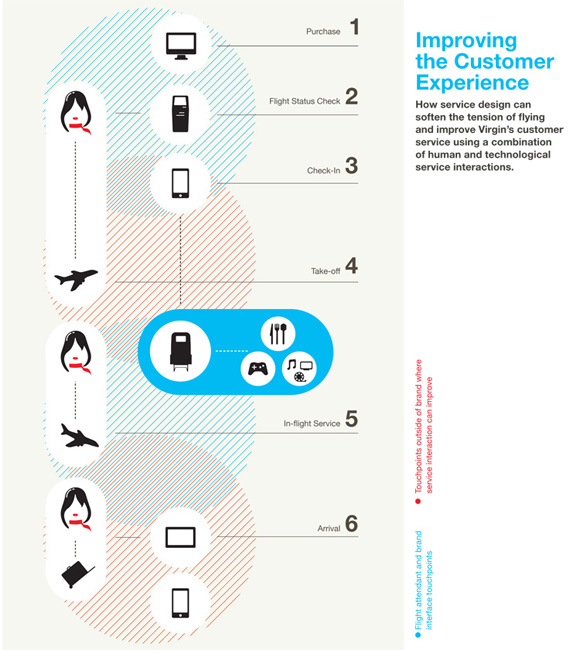
Services are comprised of many individual, and often intangible, touchpoints that happen over time and space. Because of this defining characteristic, service designers need to map out the formal elements of the producer’s work on the “back stage” with the customer experiences of the “front stage,” and the role of the “actors” on each side.
Consider the customer journey with Virgin America. Despite being known for their attention to service online and in-person, there are also several non-brand interactions that influence the travel experience: security checkpoints, delays on the runway, pesky seat neighbors. Service designers must consider these moments because they affect the overall experience but cannot be controlled. The design choices made should be continuous and prescriptive, but have enough flexibility so that one flaw does not have repercussions on the rest of the experience. After all, no trip to the airport is perfect, and Virgin would not want to be responsible for experiences over which they have no control.
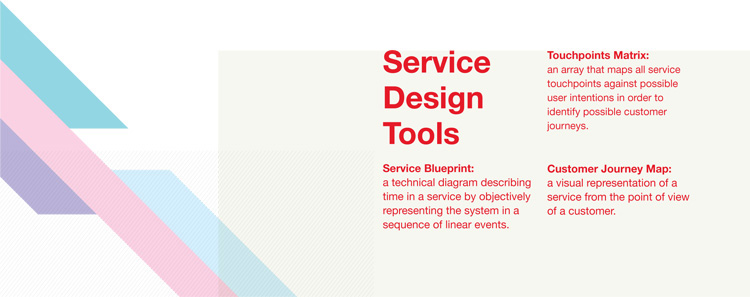
Service blueprints, touchpoint matrixes, and customer journey maps are useful tools for breaking down services into sequences. These maps explore individual roles of producers and customers while also identifying opportunities for innovation or improvement. They also prioritize ideas, plan next steps, and maintain a consistent vision. 4. Tell the Story
Traditionally, video scenarios and storyboards are tools designers use to communicate how a concept works. Service designers, however, are adept at using these tools to tell authentic and compelling stories about the people using the service. Their stories focus on the value of the concept and the nuanced experiences people have with it.
The hotel-library service example involves several touchpoints that need to be designed and communicated but there is more to the service than just that. To communicate the true value, a video about the service would feature librarians, hotel staff, and hotel guests sharing their experience in their own words. Although scripted, it is based on real-life scenarios uncovered during research. Video is a compelling storytelling tool for explaining the features that comprise a service along with perspectives of the people involved on all different sides.
Today’s devices are no longer things that people interact with but instead platforms that allow people to interact with each other and these are the stories that designers need to tell. Conclusion
In recent years, interest in service design has escalated as companies begin to recognize that innovating their service offering is the best opportunity to create competitive advantage. Product oriented brands must use these principles to deliver not just great customer-service experiences, but consumer products that enable entirely new services. In the post-digital world where processors are embedded in everything around us, these opportunities should not be underestimated, especially when the outcome is customer loyalty, brand engagement, and increased revenue. Method is an award-winning, international product, service, and experience innovation firm. 10x10 is a series of thought pieces written by Method that explores 10 emerging, industry-challenging topics. Read more about 10x10 here.
Earlier in the week, we brought you a chair designer by Läufer + Keichel with a knitted cover that can be pulled on and off like a pantsuit. The Berlin studio is at it again, this time revamping the standard armchair, with a backrest of stacked upholstered layers resembling flower petals. The modular construction of the chair, aptly named Layer, allows the Swedish company Offecct to produce a range of options using a single base: One back panel forms a stool; adding another layer, an armchair; and a third, a wingback. Läufer + Keichel originally intended to make the layers detachable, in effect creating three chairs in one, but that idea, unfortunately, proved too complicated and costly.
The three-tiered, high-backed version can be customized with different fabric textures and colors of fabric, lending a layer of whimsy to a multidimensional seat.
A Cute Toy For Kids, Where The Packaging Becomes The Parts | Co.Design: business + innovation + design
Oscar Diaz’s Tube Toys generate little waste and leave much room for imagination.
It’s an all-too-familiar holiday scene: You spend gobs of money on the latest It toy, only to watch your kid get more delight out of the box it came in. (The same goes for cats, by the way.) Well, now you can embrace the irony with a toy that is the box (or rather, a critical piece of it). The London-based designer Oscar Diaz has created a collection of vehicles--a car, fire engine, train, and tractor--that you put together from a kit of parts, including its packaging. Each Tube Toy comes with stickers and rubber wheels inside a cardboard container, which becomes the body of the car with pre-cut slots for easy assembly. The only thing that’s discarded is the paper wrapper. The end result is certainly rudimentary-looking compared to the tricked-out, sound-effect-laden plastic toys that we assume are the only things that will shake our kids out of their videogame-induced stupors. “When you observe children’s playing you quickly realize that any gap between what something it is, and what they want it to be, is immediately fulfilled by imagination,” Diaz tells Co.Design. “A toy is just a bit of structure for them to support their narrative. The Tube Toys intend to create just that structure.” And when the physical structure gives out, it can be quickly disassembled and recycled.
Tube Toys will be available in about two weeks from NPW.
Most entrepreneurs embark down that path with a mix of luck, circumstance, and insight: They’re futzing with some clunky gadget, and then boom! They realize how to fix it. Or they’ve worked so long at something that they simply know how to do it better.
Assaf Wand, the founder of Sabi, a line of branded, ergonomic wares for the aging which launches today, is a completely different sort of entrepreneur. Rather than intuiting some need out of the ether or working toward his big idea over a decade, he applied a mix of analytics, hustle, and hard work to finding an overlooked business opportunity. Thus, his example is a good argument that, while genius never arrives on demand, methodical discipline can conjure real innovation. In other words, there’s hope for the rest of us who aren’t about to invent the cure for cancer.
Granted, Wand had the benefit of training as a McKinsey consultant and venture capitalist at Draper Fisher Jurvetson. But his method should make sense to anyone who’s tried to solve a big, amorphous problem. He started by breaking the big problem down to little pieces, and moving forward based on precise lessons learned at each point along the way.
Wand had already served as the CEO of a company that was aiming to bring mobile broadband to Africa--and in that capacity, he’d raised over $400 million for his venture. But after that experience, he didn’t want to jump back into high tech. He turned down offers to become a partner at a venture capital firm. Instead, he decided to pursue another sort of business altogether: something low tech. But he didn’t quite know what just yet.
"Low-tech businesses have a massive talent gap," explains Wand. "You can go to a high-tech company and the most junior software engineer is smarter than me. But go to a consumer products company and there’s no talent below the senior management." So Wand knew that low-tech businesses were probably ripe for a disruption. And that’s when he stumbled upon some astonishing factoids: People over 50 account for 67% of America’s consumption. So they should be the most highly sought after demographic, right? Wrong: Only 5% of marketing spending is geared toward them. And if you look within that 5%, 92% of it is pharmaceuticals and financial products. "That’s when the lightning bolt hit me." He started looking around for brands geared toward boomers, and then realized that there was basically nothing. "Everything is very medicinal and disgusting," he says. "I wanted to build something a lot more positive."
Though the gap in spending and marketing was an alluring signal that a business could be found somewhere in the cracks, Wand still wasn’t totally sure. The McKinsey geek in him wanted more data, more proof, more confirmation. And so he set out to conduct a slew of focus groups and surveys--in all, reaching out to some 6,000 people.
And the insight that he found was that boomers aren’t aging like the generation before them. Their values are more progressive. They’re into organic products. They’re more worldly. They adapt to change more readily. They’re into aesthetics. But they’re not in a position of being taken care of: They’re taking care of their kids, and taking care of their own parents, even as they’re aging into worse eyesight and arthritis. "That’s when I officially launched Sabi," says Wand.
At this point, Wand brought on Yves Behar and Fuseproject, choosing them over other, bigger design firms because of their track record working with entrepreneurs. Fuseproject had, incidentally, already done a lot of thinking about products for the aging. So it would have been easy for them to create a one-off product that served them. That’s not what Wand wanted.
He made a list of the brands he admired, from Oxo to Simple Human. He quickly realized that all of them had success in branding a space that had never been successfully branded before: For Oxo, it was kitchen utensils; for Simple Human, it was trash cans. By operating in an unbranded space, you have less competition. You can demand more margins. And you can push the envelope more, because consumer expectations haven’t been carved in stone.
But you can’t create a brand with just one product. You become too hit dependent, and you can’t really serve the needs of an entire audience. Behar agreed. "If you’re going to start a brand, depth is key," says Behar. "If you’re going to talk to a user about their everyday lives, you better consider every facet." So Wand and Fuseproject set about figuring out what categories would allow them to create the most products at the most reasonable cost. And from there, they settled on products that would solve the everyday pain of taking pills.
Behar and Wand knew they wanted to get away from the medicinal look of the category. For example, most easy-open aids for pill bottles look like emergency handles. They’re red, and they shout to the world, "I’m a person with arthritis!" "These products try to solve the problem by pointing at it. They tell the user and everyone who knows them that they have a problem," says Behar. But boomers, as Wand had found, aren’t yet ready to acknowledge their infirmities. They’re fighting against the realization. How do you design a product that most people would rather not admit that they need?
The solution that Fuseproject proposed was to have the ergonomic features become a subtle feature of the design. They’d be a seamless part of the form factor. Thus, the fluted tops of the bottles and pill cases you see above allow them to be opened with the palm rather than the fingers. They’re even colored blue, to tell you where to interact with them. But all of those details simply look like good product branding--a visual identity for the product--rather than an emergency lever.
After all that research and effort, you’d think that Wand would be happy to describe Sabi as a disruptive brand aimed at boomers. But he’s quick to say that this isn’t what Sabi is at all. It might serve the needs of boomers. That might be the user whose needs inspired the products. Instead, Wand recognizes that a new brand needs to be more inclusive, so they’ve been very careful in the marketing materials not to make the appeal too overt or specific. After all, most people of adult age take at least one pill a day. "We don’t want to deter a younger crowd," says Wand. "We spent a lot of time creating a brand that isn’t associated just with age, but rather the best product we can give to people. Even though we started with boomers and their needs, our designs move us beyond, to a bigger audience."
Peter Drucker wrote, “The customer rarely buys what the company thinks it sells him. One reason for this is, of course, that nobody pays for a ‘product.’ What is paid for is satisfaction.” Companies think they are selling products and services, but in reality people hire those products and services to get jobs done in their lives. As marketing guru Ted Levitt quipped to his students a generation ago, “People don’t want quarter-inch drills--they want quarter-inch holes.” A problem arises, and the customer looks around and chooses the solution that gets the job done better than competing alternatives.
To discover your quarter-inch holes, obsessively search for the job that is important but poorly satisfied (for more on the underlying theory of jobs to be done, see The Innovator’s Solution by Clayton M. Christensen and Michael Raynor). Innosight’s research and field work over the past decade suggests that following three specific activities can increase the odds of identifying innovation opportunities.
In 2000, when A.G. Lafley became CEO of Procter & Gamble, he found a company that had lost its way. The stock had plunged almost 50% after a March 2000 warning that the company would miss earnings estimates. Lafley looked for simple ways to reenergize that company’s innovation energy. He came to the conclusion that P&G needed to fundamentally reorient itself. The company was world renowned for driving decisions based on deep customer understanding, but upon reflection, Lafley realized that the company had drifted away from that understanding.
Lafley is gifted at communicating complicated ideas in simple ways. He developed a simple mantra to refocus P&G: The consumer is boss. He would say something along these lines: “Fellow P&G-ers, I’d like you to meet your new boss. You may think that I, as your CEO, am boss. That’s not right. You might think that the board of directors to which I report is boss. That’s not right. You might think our shareholders are the bosses. That’s not right. You might think your line manager is boss. That’s not right. We have one and only one boss that matters. The consumer. The consumer is boss.”
Lafley urged P&G to understand their boss as never before. P&G had to hear what the consumer was saying and, much more importantly, tease out what the consumer wanted but couldn’t articulate.
To do this, Lafley worked to create a culture where everyone in P&G--from the chairman down--would spend time living with consumers, shopping with consumers, or working alongside consumers. He would describe invaluable insights he personally obtained in his career by spending time in the market. For example, while Lafley worked on Tide branded laundry detergent, P&G would regularly administer quantitative surveys to assess the quality of its product and packaging. Consumers reported that they loved Tide’s packaging (at the time, Tide was packaged in cardboard boxes). Yet, when Lafley was interacting with a consumer, he noticed that she almost always used a screwdriver or scissors to open the Tide box. Lafley realized that the woman didn’t want to risk breaking her nails opening the cardboard box. She said she loved the packaging because she didn’t know of any alternatives, but in reality, she had to find a creative way to open the box because of its design limitations.
Many P&G products trace their inspiration to these kinds of observations. For example, watching a woman grow frustrated when she spilled coffee grounds on her floor helped to inspire P&G’s Swiffer quick cleaning line, which today produces more than $1 billion in annual revenue.
One of the dirty little secrets of innovation is that even the most well-intentioned people lie. They say they will do things they won’t, and purport to have interest in things they don’t. Spend time in the market so that you can know the customer better than they know themselves. How to get started: Detail the amount of time you spent with customers or key stakeholders in the last three months. Find a way to triple that time.
Carefully studying current and potential customers often highlights workarounds that customers create to make up for the limitations of existing solutions. Drilling into these compensating behaviors can help to unearth innovation opportunities.
Consider jeans shopping. Research shows that women find it the second-most intimidating shopping experience, behind shopping for swimwear. In 2009, as part of an ambitious innovation program, VF Corporation, which makes Wranglers and Lee Jeans, began to spend more time with customers in order to understand specific points of frustration.
One trip to a local department store proved particularly illuminating. Executives watched as a prospective female customer shopped for a new pair of jeans. She wandered around the endless racks of clothes in the store, picking up pair of jeans after pair of jeans. The VF team was struck by two observations: First, the sheer volume of jeans the woman brought into the dressing room. Second, the fact that the woman had picked up multiple sizes of just about every pair she was trying on.
The executives assumed that she must have recently experienced a weight change, so she was unsure of her size. But in fact it turned out that her experience taught her that the sizes that appeared on the labels of jeans only loosely related to what would actually fit. Her workaround involved bringing in volumes of pairs of jeans in order to find one good fit.
These observations helped the company focus its innovation efforts on the jeans-buying process. VF changed the labeling on its jeans, developed innovative display mechanisms in retail stores, and launched an online campaign where noted style icon Stacey London helped women find jeans that would be most appropriate for their body type. In early 2011, VF reported that these and related innovation efforts had created $100 million in incremental revenue in its jeanswear division. How to get started: Lead a round-table discussion to identify compensating behaviors that your company’s solution forces customers to follow.
The natural tendency for would-be innovators is to study existing customers who participate in existing categories. By all means do that. But also look for people who face some kind of constraint that inhibits their ability to solve a pressing problem they are facing in their lives. Apple, Southwest, Ikea, Nintendo, and many more companies trace their success to unlocking demand that was pent up because existing solutions were too expensive or complicated. These companies found a market opportunity just sitting there, waiting for someone to develop a convenient, affordable solution.
Indian conglomerate called Godrej & Boyce used this approach when it developed its ChotuKool refrigerator, designed for 85% of the Indian population who didn’t purchase refrigerators. These consumers wanted some of the benefits of refrigeration, but needed something that was smaller, more portable, and less power hungry. The ChotuKool addressed these barriers to consumption. The size of a small cooler, it costs an affordable $70 and is battery powered, so it can run off the grid when electricity is down. The product exceeded sales expectations during a trial launch in 2010. In early 2011, Godrej won an award from the Indian prime minister for its efforts, with sales accelerating dramatically.
It takes some mental discipline to look to markets that don’t exist. But that discipline can pay off in the form of growth opportunities that are hidden in plain sight. How to get started: Write down five things that a coworker or friend can only do by relying on an expert or going to a central location. Think about ideas that would let these people do it themselves.
* * *
Spending time with customers, watching for workarounds, and exploring nonconsumption helps to highlight exciting innovation opportunities. Of course, there’s more to innovation than the spark of an insight. Innovators have to translate that insight into an idea that gets the innovation job done and delivers against whatever metric matters (revenues, profits, process performance, employee satisfaction, and so on). But the right starting point makes the journey infinitely easily. This article is an excerpt from The Little Black Book of Innovation: How It Works, How to Do It