E-commerce is one of the fastest-growing sectors in technology and is
poised to get even hotter, with sales expected to double between 2010
and 2015, according to
eMarketer. So how can discerning investors find the most promising opportunities? They have to first take off the rose-colored glasses.
While innovative, fast-growing e-commerce companies abound, many of
them will not succeed in the long run. For all the opportunity, it
remains extremely difficult to build a great e-commerce company that
truly and repeatedly delights the consumer.
At Norwest Venture Partners (NVP), we’ve been shopping in the
e-ommerce market for years. The companies that rise to the top of our
list have one thing in common: an obsessive focus on the consumer
lifecycle, which can be measured and managed in many ways. For me, it
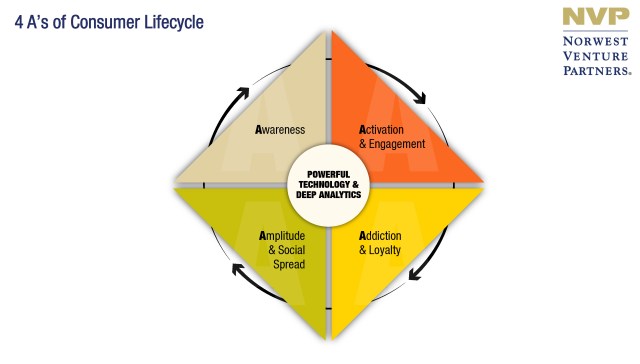
boils down to four key elements that I refer to as the 4 A’s: Awareness,
Activation, Addiction, and Amplification.
Amazon.com exemplifies the 4 A’s cycle. In 1994 Amazon began offering
readers a much larger selection of books than would ever fit on the
shelves of local bookstores. The startup gradually improved and extended
customer experiences and engagement as it expanded far beyond the book
realm. Massive brand loyalty turned Amazon into the world’s largest
online retailer, a household brand, which benefits from loyal customers
praising it in online and offline social conversations.
The Cycle Begins: Awareness
The cycle starts by using a variety of channels to expose prospective
customers to your brand, attract them to your e-commerce site, and get
them to revisit and start to engage. These channels may include direct
marketing (e-mail, direct mail, catalogs, etc); search-based advertising
and marketing; social networks; and mobile technologies. The precise
mix is dictated by the habits of the target audience and can generate
powerful cross-channel synergies.
Tracking visitors, Monthly Active Users (MAU) and monitoring social
chatter can measure awareness. If you can, give pre-purchase users
enough reason — such as a delightful digital experience — to Facebook
Connect, comment, register or log in on subsequent visits. You can
collect more detailed statistics implicitly and/or explicitly and propel
users to the activation stage.
Activation and Engagement
The Activation stage starts with a transaction. Consumers will
purchase something, and perhaps register for future interactions.
First-time impressions are critical, so obtaining feedback on the
product and the entire experience at this stage is critical. Tools such
as the Net Promoter Score can measure satisfaction levels and start
separating out your evangelists from your detractors.
Tactics that can distinguish your site at this stage include unique
merchandising, a superior user interface, more granular personalization,
seamless accommodation of mobile devices, and streamlined logistics.
Revel Touch is a company that fosters activation by extending a
retailer’s footprint to the fast-growing iPad channel. It also helps
lead into the addiction phase by turning a retailer’s website into an
app that can be as sticky and engaging as a game.
Addiction and Loyalty
You reach the Addiction stage when you have captured some significant
mind share. You get a high level of repeat purchases from your
customers, and your site becomes the first thing they think of when they
want to buy something in the category or occasion your brand
represents.
Apple can boast a very addicted customer base, the foundations of
which pre-date the web. When Apple releases a new iPhone, legions of
passionate evangelists are ready to tout it. An addicted customer base
is ready and willing to be engaged, with e-mail campaigns, contests,
games, and links from social sites. At this stage it is important to
measure everything in the sales funnel, quantify delight factors, and
keep a close eye on customer service metrics.
As customers get more addicted, you will see increases in
purchases-per-buyer ratios and average order values. There are also
mind-share metrics that help you measure brand loyalty.
Creating a personalized connection with each customer is critical to
the Addiction phase. Companies like Certona, SailThru, and MyBuys that
create personal recommendations and promotions can help boost loyalty
and build devotion.
Amplification and Social Spread
Once you have established a cadre of addicted evangelists, they will
start promoting and amplifying your brand to others. If you track and
further engage with your best customers and empower them via Facebook,
Twitter, Pinterest, Extole, Kenshoo and other social tools, they can
amplify your message endlessly.
You can increase evangelist impact in the Amplification stage by
making effective use of social media measurement and marketing tools.
Other Amplification tactics include personalized offerings, incentives
that encourage social sharing, and tell-a-friend campaigns. Good
customer testimonials are worth their weight in gold at this stage.
Key metrics for the Amplification stage include buyer/sharer ratios; a
traffic mix that is increasingly organic; lower customer acquisition
costs; higher repeat purchases; Net Promoter customer loyalty scores;
and viral coefficients. Ultimately, a delightful service with a high
measure of evangelists and low level of detractors should translate into
higher Awareness, beginning the cycle again at the first A for a new
wave of customers.
Fab.com has nailed Amplification with a product feed that ties
directly to a consumer’s social graph. Built to be extremely social, the
amplitude is that company’s most valuable asset.
The Wow Factor
The 4 A’s cycle hinges on delighting customers, and just what
constitutes customer delight varies from one e-commerce brand experience
to another. What makes your product — or how you sell it — stand out?
Zappos sells products that are quite ordinary and uses massive
availability and no-hassle returns to delight customers. Zappos offers
the same brands at roughly the same prices, but carries most sizes and
widths. You will find what you want. Zappos also removes some of the
risk of online shopping, by offering a very friendly returns policy and
great service.
Another great example is Gemvara in the jewelry category. Gemvara
delights you with customized products that don’t exist until you create
them, and engages you with enjoyable virtual renderings of inspiring
jewelry that exists nowhere else.
ModCloth sifts through the fashion universe and carefully curates
vintage and retro-inspired clothing. You don’t know what you will find,
but you know it will be on-trend and beautiful.
E-commerce has undergone massive changes since Amazon first opened
its virtual doors in 1994, and there is no sign that the transformation
is abating. This continuing disruption favors agile startups that deeply
understand and obsessively measure their unique 4 A’s of the consumer
lifecycle: Awareness, Activation, Addiction, and Amplification.
With each turn of the cycle, the customer base increases rapidly
while customer acquisition costs drop and the lifetime value of each
customer goes up. The result is a high-worth and durable e-commerce
brand that scales and delivers high profits.